 Hedayat Reda
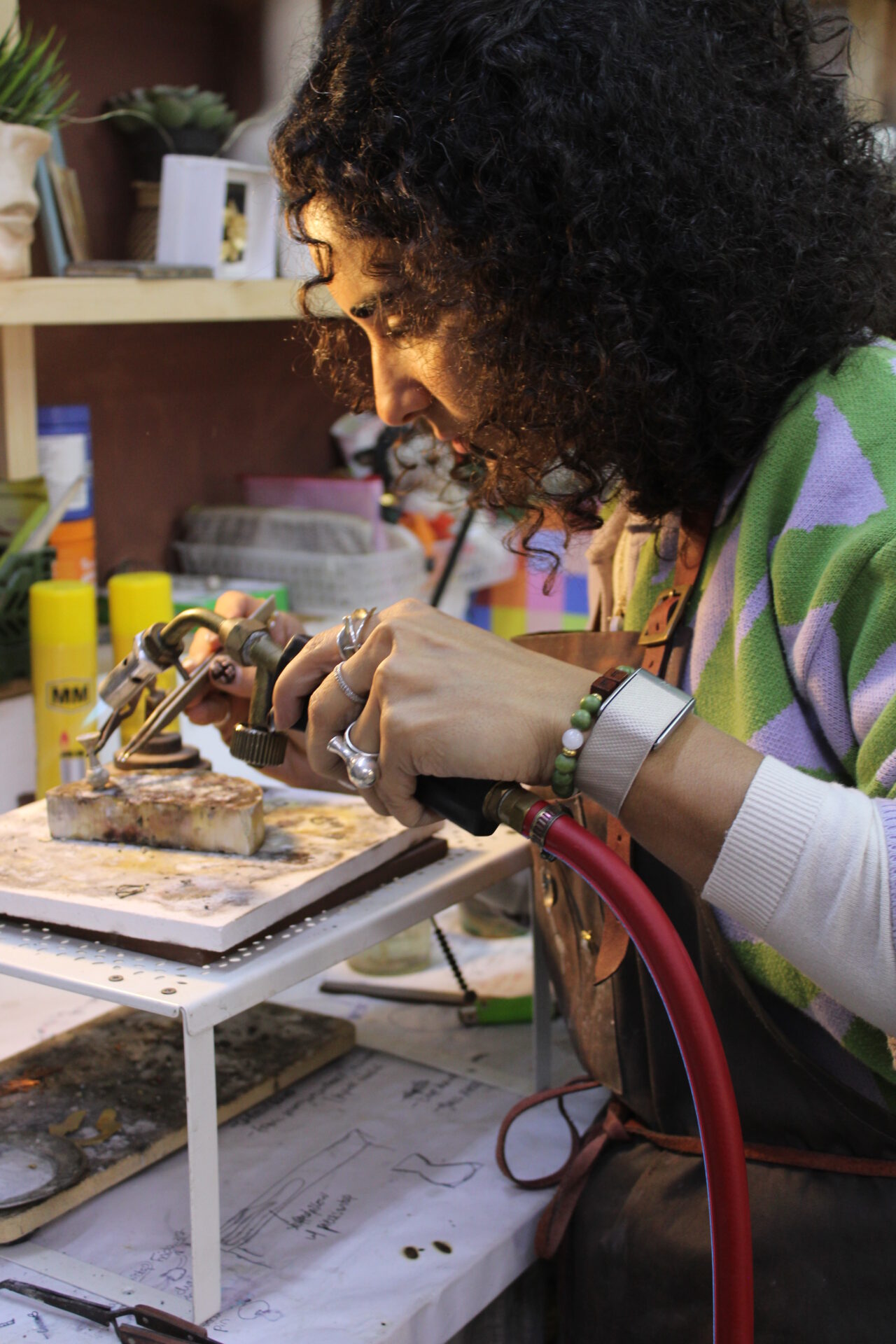
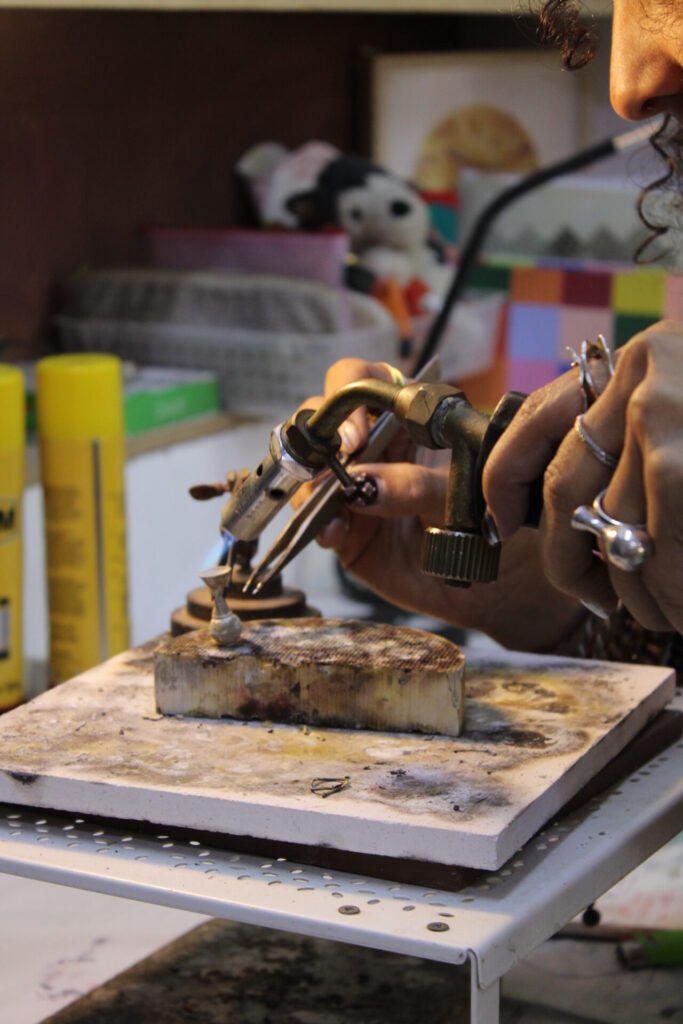
 “As soon as you experience something new you can’t unsee it…” Farah’s words come back to me as I stand in her Gemstones jewellery workshop holding a torch in one hand and a pair of tweezers in the other, attempting to set the precious stone—just so—before the molten silver changes shape. I miss a few times, and Farah assists me with the blowtorch, as we place the amethyst in the middle of the melted constellation.
That jewellery making or crafting is a tough industry, especially for a woman to dominate, goes without saying. The ‘day of the maker’ has given way to the day of the “pre-made” and “where can I get it cheaper?” And, although one-of-a-kind pieces are definitely making a comeback today, it still takes a lot of educating the consumer on the value of what he is receiving and the care and thought that goes into it, to start initiating a shift in the culture.
In this landscape FforFarah, or Farah Abdelhamid, stands as a unique North Star to all of those to whom metalsmithing and jewelry-making calls. A formally trained jeweller, Farah studied Jewelry and Metalsmithing at the Rhode Island School of Design, in Providence, Rhode Island—a small state on the east coast of the United States of America.
“One of my favourite things is when mothers come in with their younger daughters and you can see the body language of the girl: being interested but not wanting to show it, kind of shy, looking around…”
Farah tells me as we make our way through her studio in Maadi on Road 232 on a sunny morning, the light streaming through her brightly lit space.
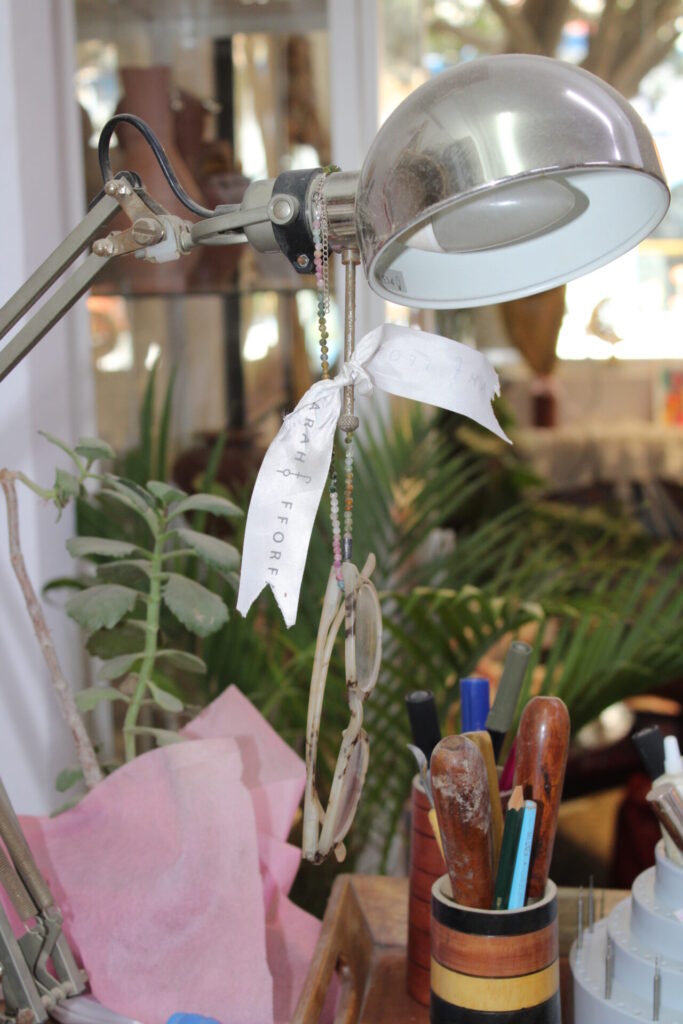
Farah’s almost 1-year-old studio/workshop/gallery is a vibrant brick-inlaid ground-floor building with a huge glass window that leads to her display table and the myriad of artworks she has collected from her forays around the world. A diplomat’s daughter, Farah grew up everywhere: Geneva, Lebanon, Austria, Berlin—but it wasn’t until her final years in high school that she moved back to Egypt and reconnected with our capital. Her cosmopolitanness comes through in the layout and curation of the studio—an artist’s haven that is focused on learning, material, and memory: loaded with books, art installations, jewellery pieces, and tools of every kind. The vibe is contemporary, but antique in a way. Reminiscent of a cool Soho art space, or a new Brooklyn-chic design shop— my ex-NYC resident brain can’t help but compare.

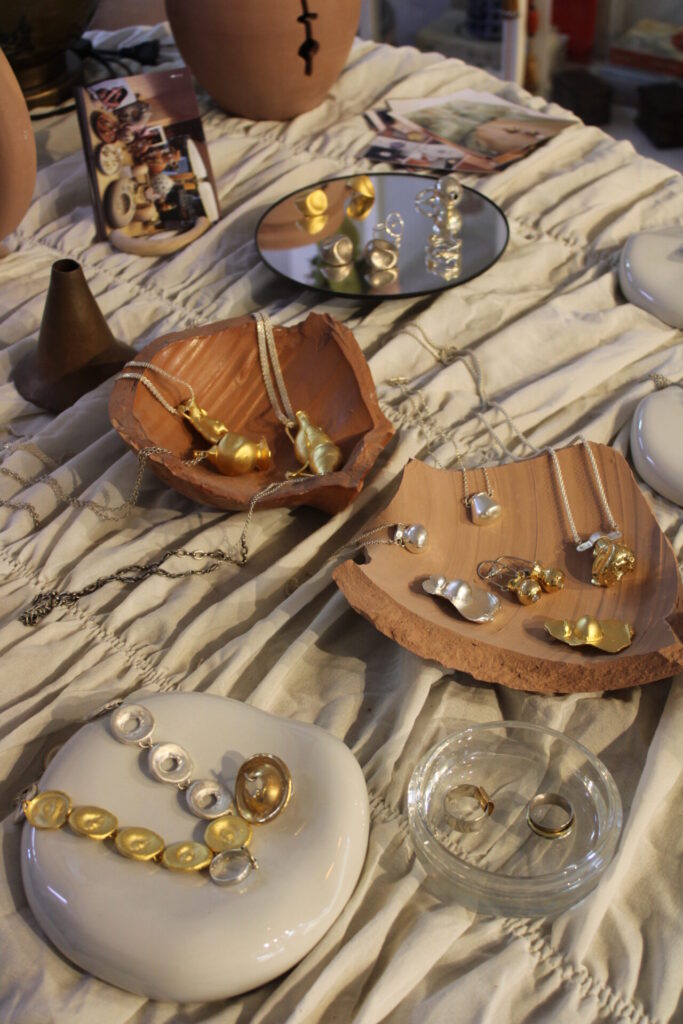
“What is the difference between a creative and a maker?” I ask her, fingering an intricate chain on the display table and bringing the conversation back to one we have had frequently over the past two years of knowing each other.
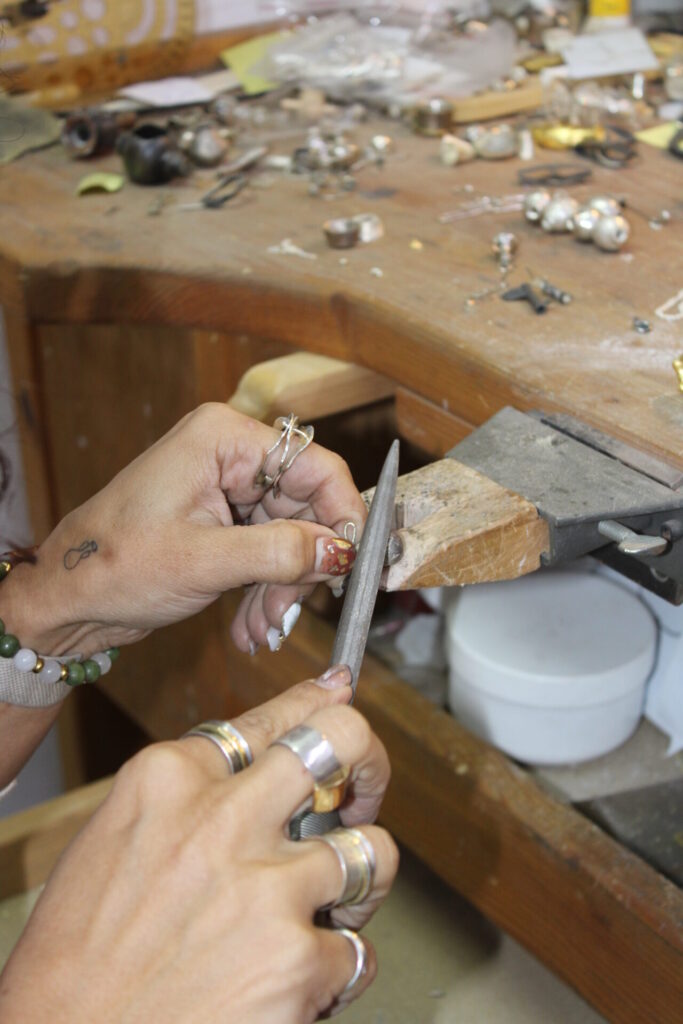
“In making, my priority is to the process and the piece. Before I start making a piece I visualize and model it. In the process of making, I am in tune with the piece and the ‘order of operations’, so to speak: what to do before what, what to do next to complete what I am working on… There is so much that is said between mind and hand and material. It is a kind of holy space.”
An intentional storyteller and analytic mind, Farah is a crash course in history and purpose. Since she graduated from RISD in 2015, the jeweller has made her home in Cairo, amongst the werash of Khan Khalili and the unpredictable roads that lead to and from her workspace(s). First in Darb 1718 (recently demolished) and now in Maadi. Everything she makes, she makes from scratch: from sourcing, to designing, to constructing, to welding, to finishing. Having met Farah through an impromptu diving trip that we took together two Octobers ago, I have learned that she is always on the go: designing her next pieces, participating in international art exhibits, launching bespoke heirloom collections, raising funds for breast cancer awareness…It is rare to meet such a powerhouse who is also so young and driven. And yet, the more you peel back her layers, the more you discover that love of learning and spreading her knowledge are at the foundation of all that she does.
“FforFarah became FforFarah unknowingly… In 2019 I was selected to participate in Milan Design Week, for which I had to design a commercial collection. The collection was called ‘Made to Form’- the vessels that are now an intrinsic part of my identity. But there, in the moment of truth, I only sold three pieces (of forty). As a way to break even, my mom suggested that we host an evening in the studio at Darb and try to sell the remaining pieces. So I planned a pop-up event and invited friends and family and friends of friends. The pop-up was a hit, and I believe it was the following week when I wrote FforFarah as my Instagram handle—I couldn’t write Farah Abdelhamid (it was too long). Now it’s the name of the gallery.”
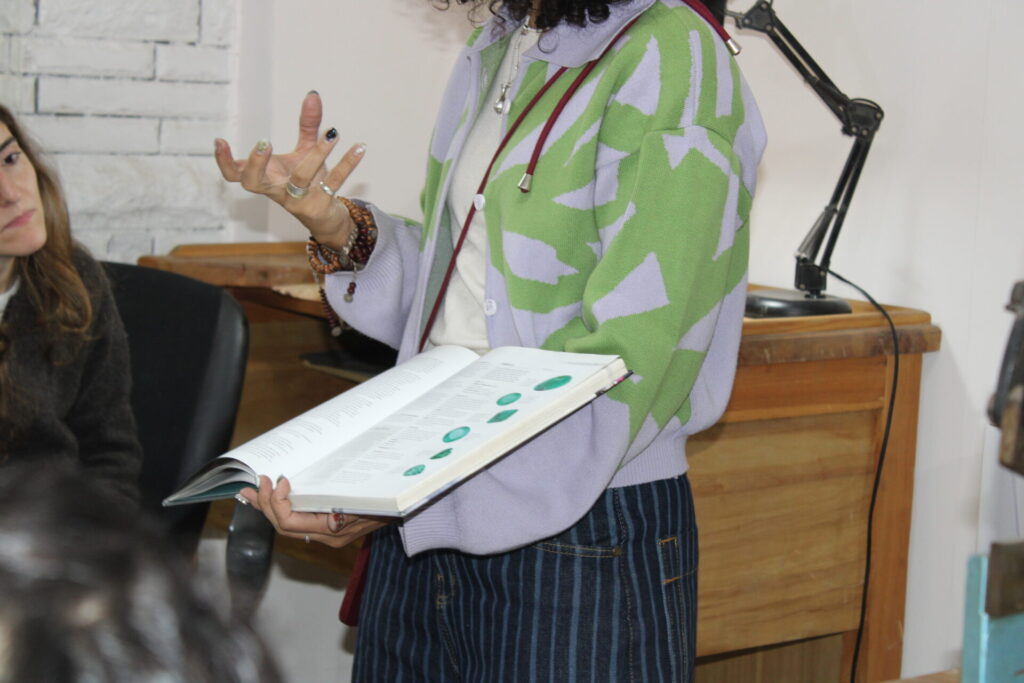
People’s reactions to her work, the way her work is viewed and received, the way it is connected with, is what fuels Farah as a designer. On reconnecting with Cairo after uni, Farah immediately pursued teaching through the Azza Fahmy Design Studio, a program she helped build and direct. Her university classes on Spatial Dynamics, The Psychology of Colour, and Bodies and Form, built a foundation for seeing the world through an academic lens, and a natural integration between work and mission, one she felt she had to pay forward.
“Seeing people experience something for the first time creates a really strong bond. I was in the studio holding a hammer once, when a six-year-old girl came in. I realized this was a chance to break so many stereotypes—a teaching moment.”
One of many, for Farah.

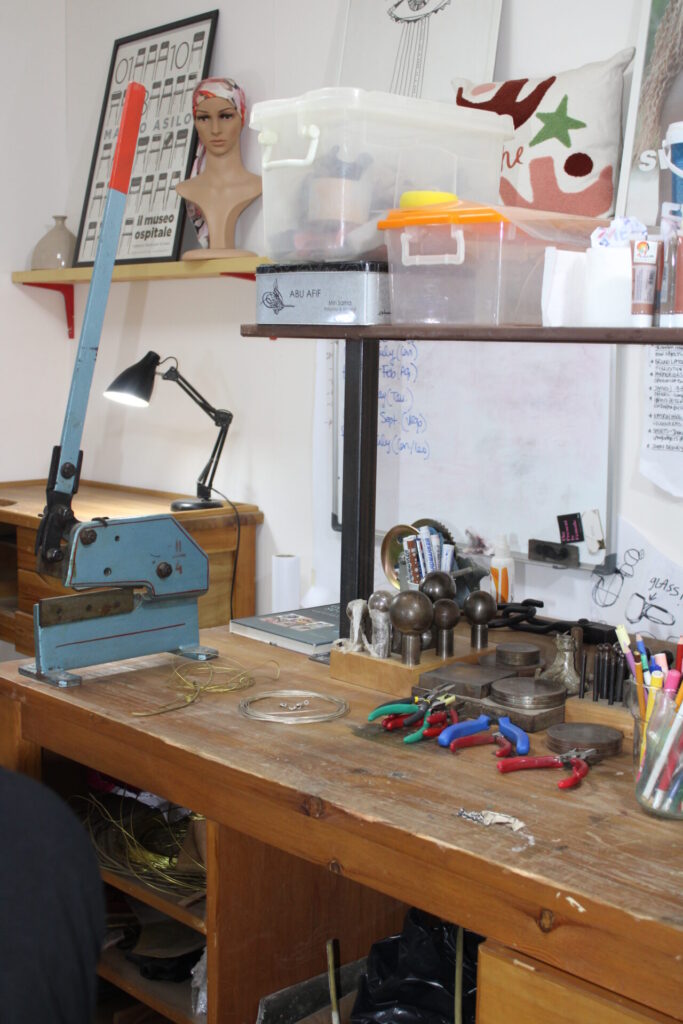
Teaching is an integral part of Farah’s philosophy. In her new studio there is an entire room set up with work stations for the workshops which have become a cornerstone of her offerings. From rings, to charms, to personalized wedding bands, Farah believes in the value of slowing down and working with one’s hands and what it means for the pieces that we connect with and our human experience.
“I only do classes with up to 6 students because the exchange is so intimate and powerful. The people I interact with teach me things and make me see things in a new way.”
“How is working with jewellery here different than it was in the U.S?” I ask, curious about the transition from RISD to Khan.
“For starters, there is no RISD store here,” Farah jokes, throwing her head back and laughing with heart.
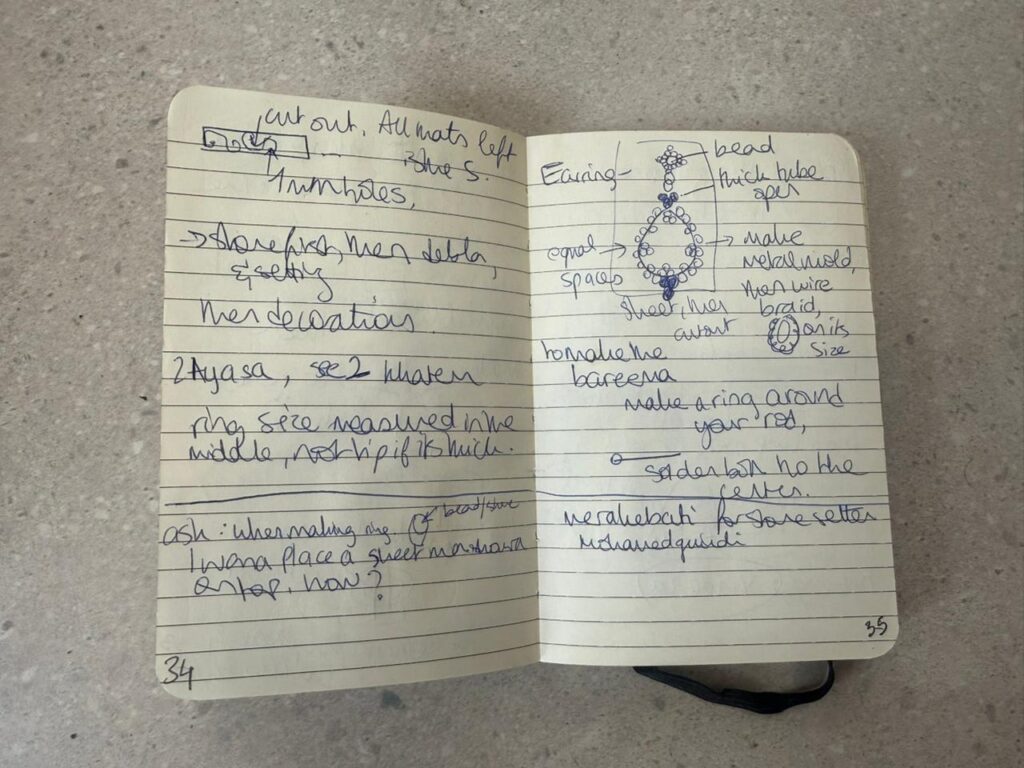
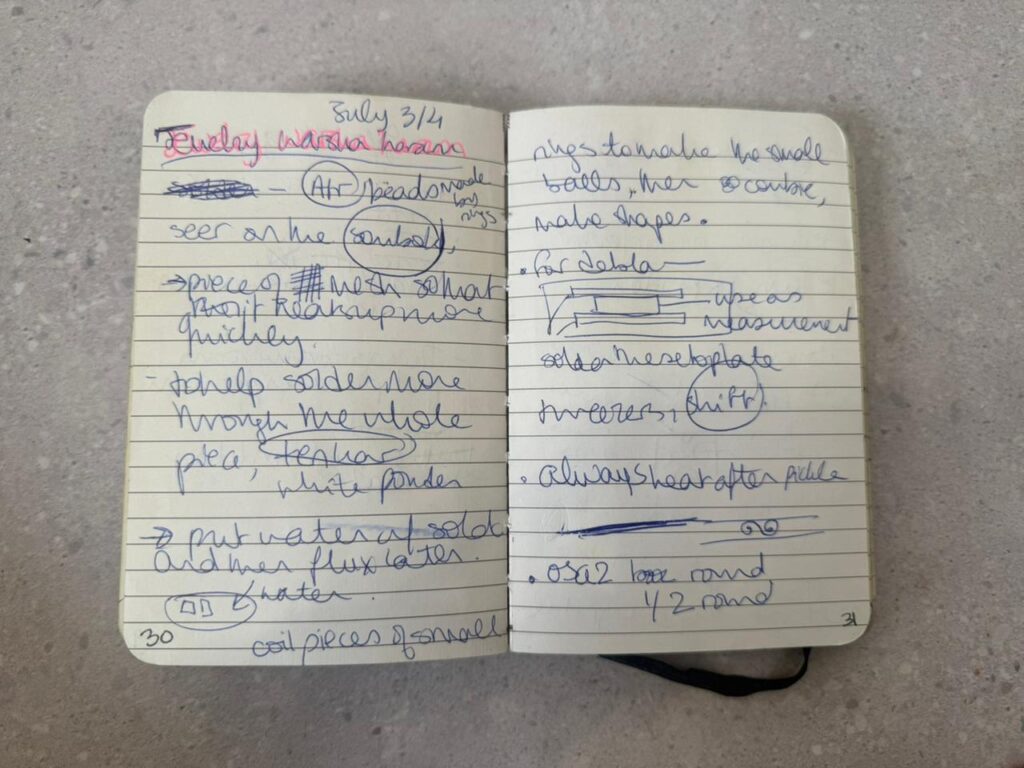
“One summer, I decided to do an internship at a jewellery store I really liked in Dokki. I wanted to learn under the sanay3eya—as a ‘sabi’. They had a warsha in Haram, but when I met the lead designer of the warsha, she sat me in another room all alone. ‘I want to work downstairs—with my hands’, I explained, thinking this was obvious. They didn’t seem to grasp the concept. Eventually I developed a very parental relationship with the lead craftsman. I would shadow him with my notebook where I would translate the Arabic words he uses into English. Now I know that ‘shift’ is tweezers and ‘le7am’ is solder. I still have this notebook and I still add to it. That was the beginning of my Egyptian jewellery integration. I can now explain my classes fully in Arabic and English.”
Today Farah’s work comprises a range of artistic expression, from her commercial form-based collections, to her bespoke heirloom jewellery (fingerprint kits and wedding bands), to her one-off (but frequent) art installations, to the breast cancer awareness collection and campaign she leads every October entitled SHE (Strength, Health and Empowerment)—the proceeds going to the Baheya organization year-round. If she can make it, she will do it.
“The Baheya fundraiser is the closest thing to my heart. I grew up around the femme fatales of my family. My grandma is a breast cancer survivor and the catalyst for this campaign. Every year I collaborate with different female designer artists, anyone who is able to volunteer and give, to create products or workshops to educate and talk about breast cancer. So far we have raised over 500,000 EGP. I have learned that giving back is not about the struggle of the one, but of the many coming together.”
“What do your pieces mean to you?” I ask, wanting a glimpse into the mind that brought ollal to jewellery.
“The first series ‘Made to Form’, the vessels, have become my signature and the most valuable work to me. It’s an engineering study and a study of form. One of the earrings is made of twelve pieces—just on the one side. They were definitely a ‘making’ milestone for me. Another engineering category I am proud of are the pieces with movement. One of my favourite pieces is called The Retractable Dome and it’s made of three parts: neither is connected to the other, but by pulling on either side of the chain, you can change the length and the position of the pieces. It’s a play on weight and balance and movement.”


As we move through the rooms to sit outside in a hidden patio that is enshrouded with plants, we talk about the role of form in all of her designs: how femininity and the body peek through and take centre stage. Farah is currently doing her Masters in Product Design in Berlin with a thesis on The Body as a Hollow Vessel. She tells me that she believes women are not just one “her”.
“I like to wear different things and express myself differently, through clothes and music: minimally and maximally, boldly and calmly, subtly and elegantly. IIf I would personify femininity through the FforFarah girl I would expect her to love all, to appreciate all, to be as authentic as possible to herself, to be so uniquely ever-changing…
I scan her outfit briefly: a white dress shirt with multicoloured funky buttons, two-tone jeans that scream late 70s, and a work-style blazer in khaki, finished off with an oversized beige scarf—fun but earthy.
“In the pieces that I make, I hope that the way she chooses to wear and express herself with them, there is something for everything she wants to say.”
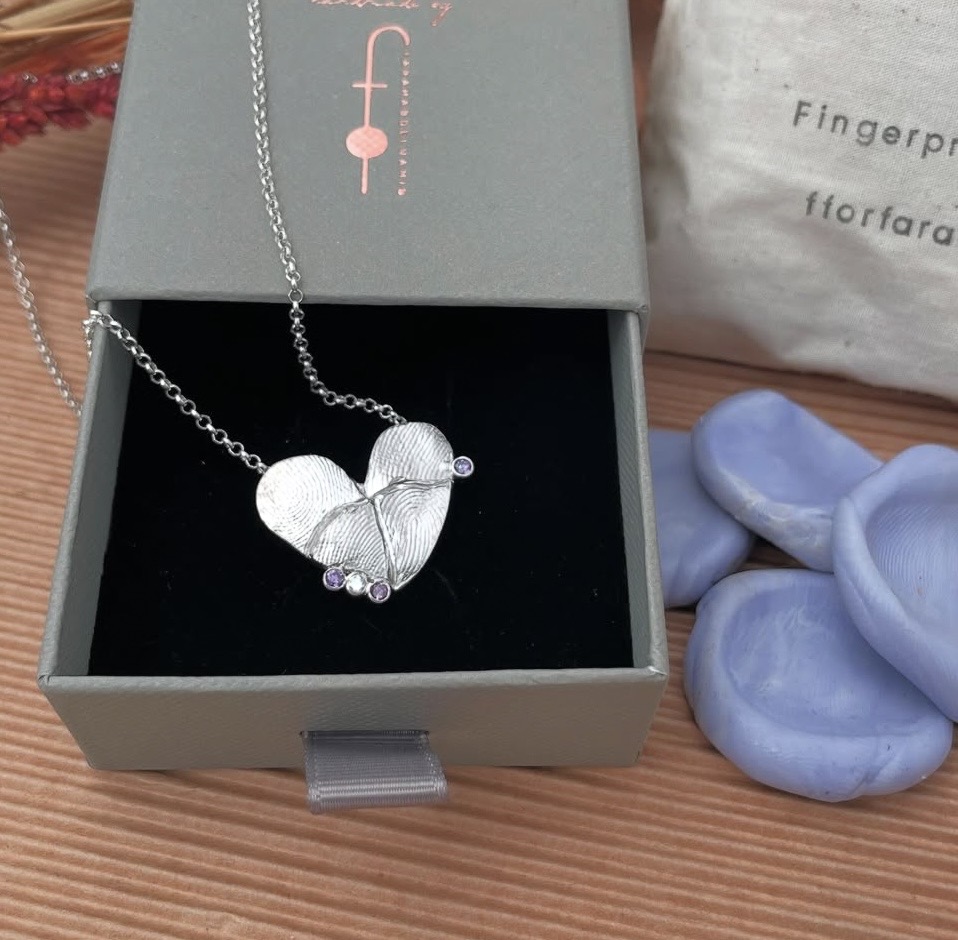
As we walk back to her workspace, I notice a custom order for a client on her desk: engravings written in Arabic and carved into silver on an interlinked chain. I recall my first-ever order from FforFarah—a fingerprint heirloom my family and I had made for my mum on Mother’s Day some years ago. The piece featured our four fingerprints—my brothers’, my dad’s, and mine—melded together in the shape of a heart with each of our birthstones adorning it. Farah has always told me it was one of the tougher pieces she put together, but its beauty and uniqueness is unrivalled. I want to ask her which of her art forms she feels closest to; instead I take another direction.
“What is your most outrageous goal for FforFarah?”
“I never wanna do the same thing twice,” she answers without skipping a beat, as if she has thought about this a hundred times. “While I am doing this work for FforFarah now, I know that I have not made my best work yet. These milestones are still leading up to the biggest one.”
In the past year Farah has designed an Ergo chair for Don Tanani, exhibited two startling vessel installations at Cairo Design Week, and is taking part in the Doha Biennale in Qatar next month—alongside her regular commercial work.
“I’m not sure if this is another goal, but I would love to do something with Schiaparelli,” Farah continues, almost shyly, expanding on her creative interests.. She recounts how she has had an e-mail draft to the company already in her inbox for the past three years.
“My heart is beating so fast as I say this- it’s out there,” she proclaims with a fierce sparkle, the kind where you know she will find a way to make it happen. I urge her to send it.
“What advice would you pass on to young makers?” I shift the conversation to a younger Farah and what she would have needed to know.
“Ask for help. Don’t do it all at once. One thing will lead to the other naturally.”
That, from what I have grasped, is the essence of Farah’s work and her philosophy on life. Each one-of-a-kind piece in the gallery tells the story of how it is made and the process by which the maker sat to let it unravel.
“Kol haga leeha wa2taha. Don’t plan before the need is there. If you are true to the process it will tell you what to do next.”
From my time with Farah and my foray into her world of craft, I have learned how a 360 philosophy can be personified. Farah roots everything she does in her appreciation for the work: from the silver she sources by hand, to the process by which she designs and molds her ethereal artwork, to the awareness campaigns and videos she films and edits herself. More so than anything though, she stays authentic to herself and her beliefs.
“By honouring the process and the materials and giving them agency I learn from each experience. Each fingerprint is unique. Each emblem cannot be replicated. Everything goes back to honouring the body and the moment, to community—which is the essence of making things,” she sums up her ethos, fixing a loose gemstone on her workspace.
While I don’t see myself ever becoming a jeweler, this conversation has brought me one step closer to understanding the link between intuition, preparedness, and agency, one I hope to take forward in my own work.