
 Nahla Zayed
 Valentine’s Day often arrives wrapped in red roses and candlelight. Yet beyond the symbolism lies a quieter, more meaningful question: How do we truly experience love?
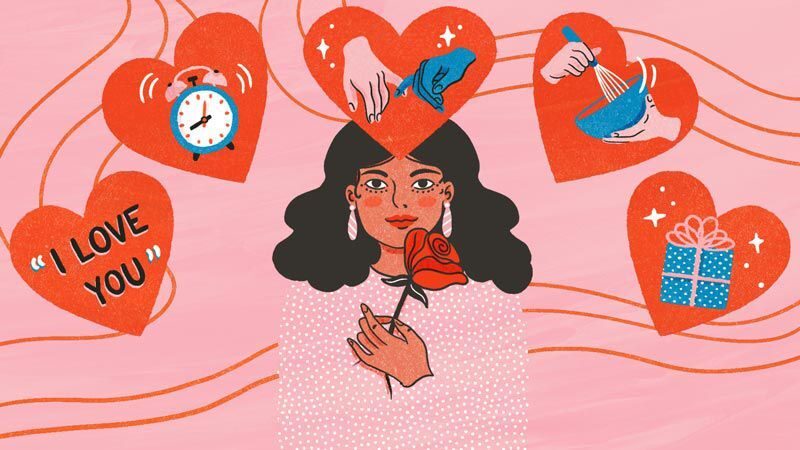
The concept of the Five Love Languages, introduced by Dr. Gary Chapman, suggests that love is not expressed in one universal way. Instead, it is spoken through distinct emotional dialects — each shaping how we give and receive affection.
Understanding these languages may be the difference between feeling adored and feeling unseen.
So today, we’re asking you: Which language does your heart understand best?
Words of Affirmation
For some, love is verbal. It lives in reassurance, praise, and intentional communication.
A sincere “I appreciate you.”
A thoughtful message before an important meeting.
A reminder that you are valued.
Words, when spoken with care, have the power to affirm identity and strengthen emotional intimacy. For those who speak this language, silence can feel distant — but affirmation feels like home.
Acts of Service
For others, love is action. It reveals itself in effort.
Preparing dinner after a long day.
Handling responsibilities without being asked.
Solving problems before they escalate.
Here, love is not declared — it is demonstrated. It says, “Your well-being matters to me.” And in that quiet devotion, there is profound romance.
Receiving Gifts
Contrary to misconception, this language is not rooted in materialism. It is rooted in meaning.
A handwritten note.
A carefully chosen book.
A small token that says, “I remembered.”
Gifts, in this context, become physical symbols of emotional presence. They are reminders that someone was thinking of you — even when you weren’t in the room.
Quality Time
In a world defined by distraction, undivided attention has become a rare luxury.
For those who value quality time, love is measured in presence.
Eye contact.
Deep conversation.
Shared experiences without interruption.
It is not about duration — it is about intention. Time, when given fully, becomes one of the purest forms of affection.
Physical Touch
For some, connection is felt most deeply through closeness.
A reassuring hand.
An embrace that dissolves tension.
The quiet intimacy of proximity.
Physical touch can communicate safety, passion, and emotional grounding — often without a single word spoken.
The beauty of love languages lies not only in identifying our own, but in recognizing the language of those we care about. Too often, we express love the way we prefer to receive it — unaware that the other person may interpret affection differently.
This Valentine’s Day, perhaps the most meaningful gesture is not extravagant — but intentional.
Take a moment to reflect:
When do you feel most loved?
Which gestures resonate with you most deeply?
And are you communicating love in a way that your partner truly understands?
Love is universal — but the way we speak it is personal.
So tell us:
What is your love language?