 Sama Farrag
 There was once a time when our vernacular did not contain words like “gaslight” and “triggered,” and “toxic” just meant poisonous. There is something slightly uncanny about the way everyone speaks now. Spend enough time online, at dinner parties, in social events, in group chats, in the bathroom line at a fashion event, and eventually the same vocabulary begins circling the room with almost religious consistency. People talk about healing constantly, with the kind of fluency that suggests emotional analysis has become a second language. We speak about trauma and suffering with the same cadence we used to talk about our favorite perfume and where the function is. Someone is healing their relationship with love. Someone else is healing from burnout. Another person is healing their inner child, their nervous system, their fear of intimacy, their tendency to self-sabotage, their anxious attachment, their avoidance patterns, their inability to receive. Entire personalities now arrive pre-interpreted and wrapped in therapeutic terminology before anyone has the chance to simply be contradictory, erratic, selfish, heartbroken, difficult, lost, or just…human. And beneath all of it sits a strange question that almost nobody asks directly because it risks puncturing the entire performance: When did life begin leaving so many people feeling psychologically injured all the time?
Not wounded in the cinematic sense. Not shattered by singular tragedy. Something far more ambient than that, more like a constant emotional abrasion. The feeling of living with your skin rubbed raw by ordinary existence. People move through modern life carrying a level of exhaustion that no amount of sleep seems capable of repairing because the fatigue has very little to do with physical rest. It comes from the endless cognitive noise of contemporary existence, from absorbing too much information, too many opinions, too many images of catastrophe and beauty and wealth and violence compressed together until the nervous system loses any ability to distinguish urgency from background static.
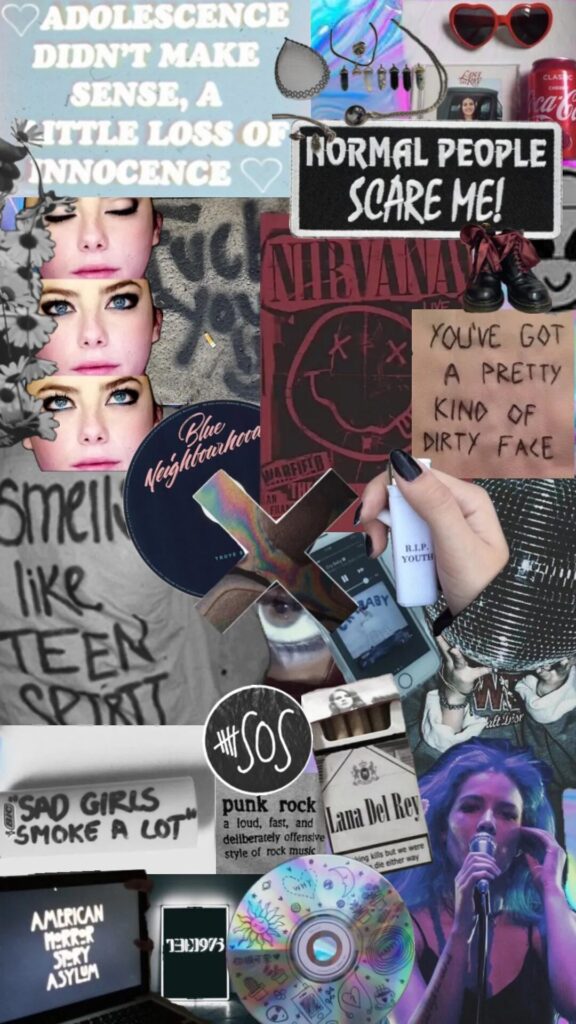
For years now, people have existed inside a culture that encourages permanent exposure. Carefully curated Instagram dumps of your Gouna trip. A TikTok of your friend’s engagement while she gets ready. A 10-year then-vs.-now Facebook challenge. Every feeling arrives with the possibility of documentation attached to it. Every breakdown threatens to become content before it has even fully registered internally. Emotions are narrated in real time, analyzed in real time, and aestheticized in real time. I myself am guilty of pulling out my phone anytime my boyfriend and I are simply having koshari at the least aesthetically pleasing place possible and scrambling to make it look like it’s straight out of a Wes Anderson film. Somewhere in the middle of this, self-awareness metastasized into a kind of social currency. People no longer merely experience pain; they demonstrate fluency in it. They know how to package it correctly, how to caption it, what song perfectly describes it (I’m looking at you, Mitski), and how to translate private confusion into language polished enough to circulate publicly. Suffering has acquired a visual identity, a cadence, even a market value.
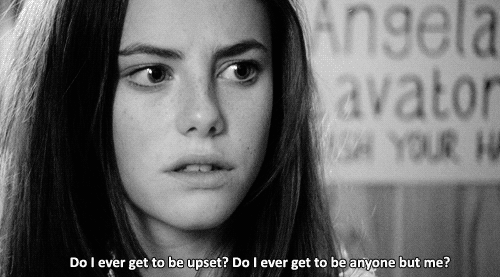
My Tumblr from 2014 was the poster child of teenage angst. All my pain, all my suffering, repackaged and repurposed and reblogged to appear. To materialize. I’d go home from school one day after having a bad day and find immediate comfort in a black and white GIF of Effy Stonem talking about “Do I ever get to be upset? Do I ever get to be anyone but me?” The internet accelerated this sadness to an almost absurd degree because platforms reward confession, especially the kind that can be flattened into universally recognizable emotional shorthand. Trauma became legible. Therapy language became fashionable. Entire generations learned to describe themselves through diagnostic frameworks before they ever developed stable inner lives outside the gaze of other people. I wasn’t anxious before I found out what anxiety was. Suddenly everyone possessed terminology for behaviors that previous generations would have simply called insecurity, jealousy, selfishness, heartbreak, fear, loneliness, avoidance, or desperation. Human complexity became indexed under searchable psychological categories.
Some of this has undoubtedly been useful. There is relief in naming experiences that once lived in isolation. I find relief in being able to identify that doing everything in 7s since I was a kid was actually undiagnosed OCD. There is dignity in understanding that certain forms of suffering are shared rather than shameful. I go to Reddit whenever I’m having a particularly tough time and find safety in numbers. But the culture surrounding healing carries another undertone as well, one that feels less like liberation and more like permanent self-surveillance. Every interaction now risks becoming evidence, every failed relationship becomes a case study, and every argument gets processed through the language of boundaries, emotional labor, attachment wounds, triggers, regulation. People speak about themselves with the detached precision of analysts dissecting subjects under laboratory lighting. The exhausting part is not merely the introspection itself, but rather the suspicion that nobody is ever permitted to emerge from it. Healing has become endless, recursive, and permanently unfinished. There is always another layer to excavate, another realization to unlock, another cycle to break. Entire identities form around the maintenance of psychological work. Some people seem terrified that without their wounds they would no longer possess a coherent sense of self at all. And somewhere inside all this hyper-analysis sits another uncomfortable question: will there ever even be a point where anyone is considered fully healed anymore? Or has healing itself become the permanent condition? What happened to simply being human—inconsistent, emotional, occasionally self-destructive, sometimes resilient, sometimes not—without every flaw requiring a framework and every feeling demanding diagnosis?
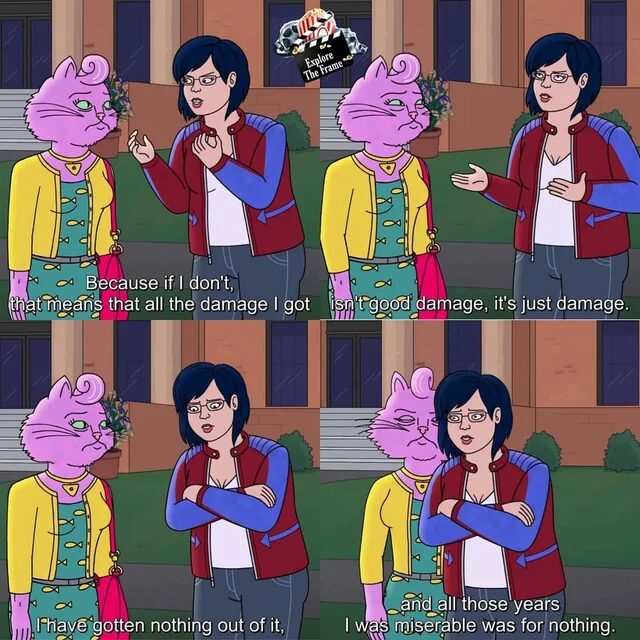
Bojack Horseman is my comfort show (a trauma I am yet to heal from), and there is one particular episode where Diane, Bojack’s ghostwriter turned friend turned Roman Empire, talks about how her damage has to be “good damage.” Diane believes that if she can turn her trauma into a memoir to help others, then the damage was good. If she can’t, she fears it is just bad damage—years of misery that mean nothing. The line lingers because it feels painfully familiar to the way people approach suffering now. Pain almost seems to require justification. It has to become wisdom, art, personal growth, self-awareness, content. There is immense pressure to transform every terrible experience into something meaningful enough to redeem the fact that it happened at all.
What makes this fixation especially revealing is the possibility that much of what people classify as personal dysfunction may actually be completely rational responses to an environment that feels increasingly hostile to human stability. Anxiety flourishes in economies built on precarity. Dissociation makes perfect sense inside cultures that overload the brain with stimulation every waking hour. Loneliness becomes inevitable when community erodes and relationships are filtered through screens designed to monetize attention rather than sustain intimacy. Of course people feel emotionally depleted after years spent absorbing nonstop crises, financial instability, political dread, algorithmic comparison, and the peculiar psychic distortion of witnessing everybody else’s lives more often than fully inhabiting their own.
There is also something deeply modern about the demand that people transform every painful experience into productive self-knowledge. Nothing is allowed to remain unresolved anymore. Every heartbreak must yield growth. Every depressive episode requires insight. Every traumatic experience eventually gets folded into a narrative arc about evolution, boundaries, and becoming. I want to feel sad without having to grow from it. I want to feel insecure without having to unpack years of middle school bullying. I want to call a spade a spade and just feel my emotions without needing subtitles for them. People speak about themselves as though they were brands undergoing strategic repositioning rather than individuals stumbling through lives that are often chaotic, humiliating, arbitrary, and unresolved for reasons nobody can fully explain.

Maybe that is what sits underneath all of this. Not every feeling needs to become a breakthrough, and not every difficult experience needs to be transformed into a lesson profound enough to justify the pain. Some things happen and stay complicated. Some people carry old versions of themselves for years. Some wounds shrink, some don’t, some simply become familiar. I still find myself feeling my sadness from 12 years ago, and I don’t want to make sense of it. I still identify with my teenage wounds and don’t want to call it “age regression” or “unhealed trauma.” I need to be human without the pressure of having to explain what makes me human. The expectation that every emotion must be analyzed, healed, processed, and evolved beyond leaves very little room for the ordinary mess of being alive.
So everyone is healing, constantly healing, endlessly healing, and maybe that is why so many people feel exhausted by the idea of it. Because what if there is no final version of a person waiting at the end of all this work? What if being human was never supposed to mean becoming perfectly resolved, perfectly self-aware, or perfectly healed? What if part of living has always been learning how to exist alongside the unfinished parts of yourself without turning them into a project to fix? It is a project that I have decided to abandon and have decided instead to rewatch Bojack Horseman.