 Sama Farrag
 Welcome to the age of Cult Alo Pilates Matcha and the ever-loving clean girl aesthetic. As a twenty-something woman who more often than not fritters away on social media, I stumble upon the same video over and over and over again. “Here’s a hack to fix your dark underarms!” “The ultimate fix for strawberry legs!” And of course, everyone’s favorite soundbite: “Run, don’t walk to so-and-so to get your hands on the newest product-of-the-week that is being marketed to women as their holy grail!”
There is no shame in having fallen for the latest TikTok trend. I myself am guilty of temporarily dyeing my skin Donald Trump orange when I was fifteen after using a turmeric-based mask to “fix” hyperpigmentation. I didn’t realize then that there was nothing to be fixed. If it ain’t broke, right? As women, we are constantly being sold the idea that we have to fix ourselves. We have to fix our stretch marks, massive pores, and cellulite. We spend money on products that ferociously promise to remedy our bodies and rectify our souls; that to experience true womanhood, you have to have a 12-step nighttime skincare routine. There is a plethora of empty promises being made that force us to look at ourselves and our bodies as a garment that needs to be probed and prodded for our betterment.

Womanhood has been repurposed and commodified to appear as a lifelong project in need of constant improvement. It’s a perfect recipe: specific flaw, imminent solution. One part lemon juice, two parts baking soda, and a whole lot of self-loathing. And who is the beneficiary? Spoiler alert: Not us! Because next week there will be another trend, another life hack, and another flaw that will throw us back into the pursuit of perfection.
While constantly inspecting and adjusting, you are made to believe that this is what makes you more of a woman. The truth, however, is that this drives us away from self-acceptance because it conditions us to reject ourselves as we are. Algorithm-driven insecurity has forced us into the crevices of hyperconsumerism and self-consciousness while branding itself as self-care and wellness DIYs. Thanks to five different videos on my FYP, I am now insecure about things I haven’t even noticed before.
It’s almost impressive, in a bleak sort of way, how efficiently the algorithm can manufacture a flaw and sell you its cure in under thirty seconds. One minute you’re watching a GRWM, the next you’re five videos deep into how to lighten your elbows. Now you’re in the mirror, fully investigating your elbows like they’ve personally betrayed you. Be honest—have they always looked like that, or is this a new development? No one tells you that the insecurity is the product. The scrub or serum or random DIY concoction comes after. And the tone is always so urgent. Like your knees are on a deadline. Like if you don’t fix this one thing immediately, your life will surely fall apart. It’s exhausting. (Also, since when did every part of the body require its own routine? Face, body, hair, scalp, lips, underarms, knees. What’s next, a nighttime routine for my shins?)
What makes it worse is how it’s framed as self-care. As if buying more and doing more and fixing more is somehow the same as caring for yourself. At some point it just feels like maintenance. Like you’re a project that’s never really done. There’s always another video, another hack, another tiny detail you’re now expected to notice. It’s like being introduced to new insecurities on a weekly basis. I didn’t even have time to process the last one. I’m still processing my insecurities from when I was a pimple-faced teenager. Now I have more to worry about? My pimples weren’t even that bad, but God forbid a prepubescent girl show up to school with a blemish or a zit. I think that was around the time I started picking at my skin because I simply could not bear the idea that my skin wasn’t as picture-perfect as whoever was on the front page of PopStar magazine in April 2011. (Kristen Stewart maybe?)

The strangest part is realizing that five minutes before that video, you were completely fine. Not perfect, not airbrushed—just… normal. Existing. And then suddenly that’s not enough anymore. I don’t think the answer is to completely stop caring or throw everything out. But maybe it’s just pausing for a second. Ask yourself if this is actually something you care about or something you were just told to care about. Because a lot of the time, it’s the second one.
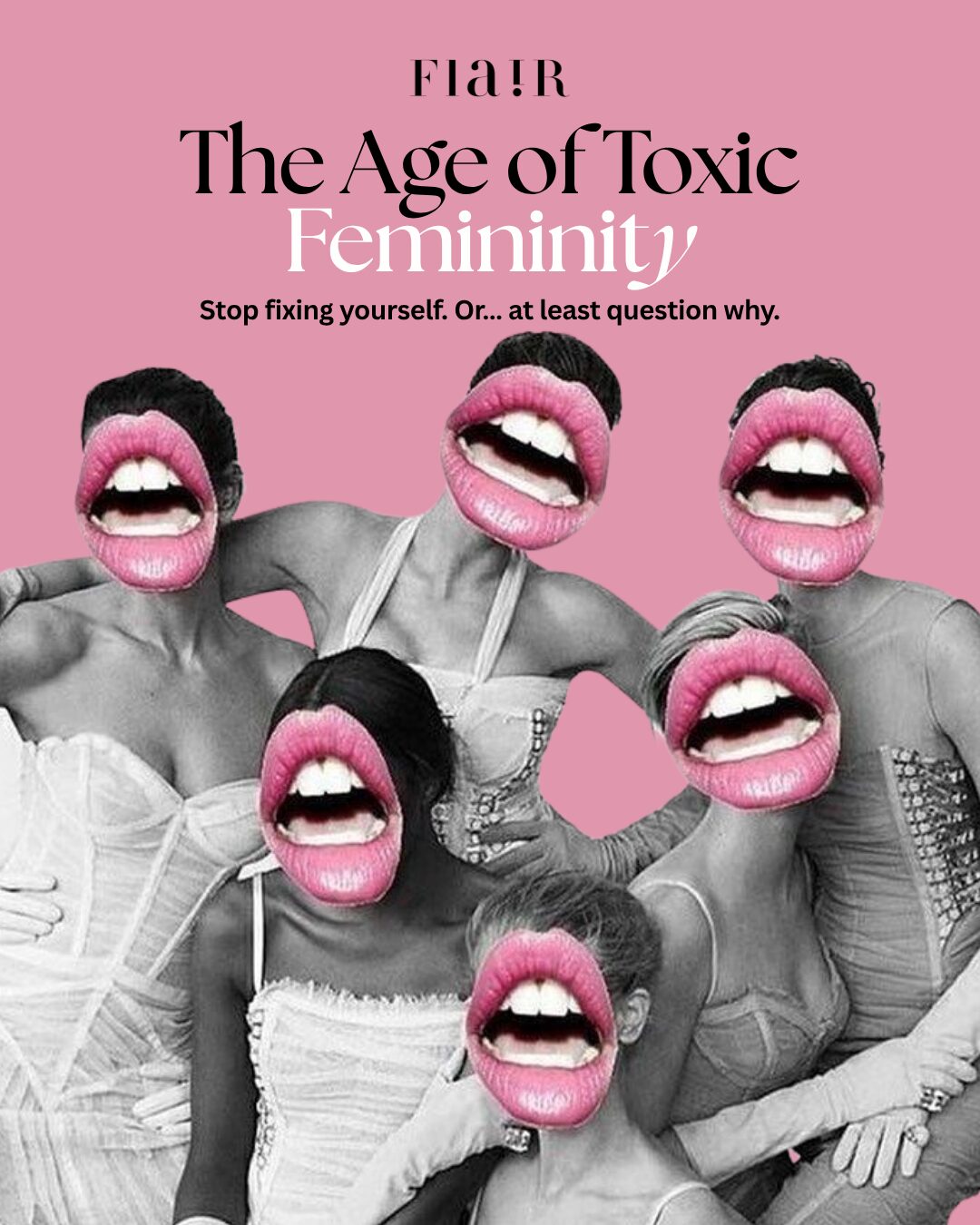
This is not empowerment, and it’s not self-care either. It’s a patriarchal pressure that is dressed up in pink and drenched in sugar and honey. It’s an odd version of femininity that we have decided to land on—one that looks soft and intentional on the surface, but underneath it is rigid, demanding, and practically impossible to keep up with. Everything is curated, optimized, and improved. You are not expected to exist as a woman but to constantly refine yourself into one. It’s difficult not to see it as a kind of toxic femininity—one that trades in insecurity while rebranding as confidence. One that tells you that you are doing this for yourself while handing you an ever-growing list of things to fix. The more you buy into it, the further you get from ever feeling finished with the project. Because there is no “finished,” and that is the whole point.
So maybe the only real way out is to recognize the pattern for what it is: a system shaped by the patriarchy that profits off women’s insecurities, where toxicity is disguised as self-improvement and constantly reinforced through new flaws that need fixing. Question it, laugh at it, opt out when you can. Not in some grand and dramatic all-or-nothing way, but in seemingly small and insignificant moments. Choose not to care about something you were told to care about. I promise you dark underarms are really not a problem. Let some things just be. The most radical thing you can do in an age that profits off your self-doubt is to decide that you’re already enough without fixing a thing. And in my opinion, existence without self-correction is the truest form of resistance.