 Sama Farrag
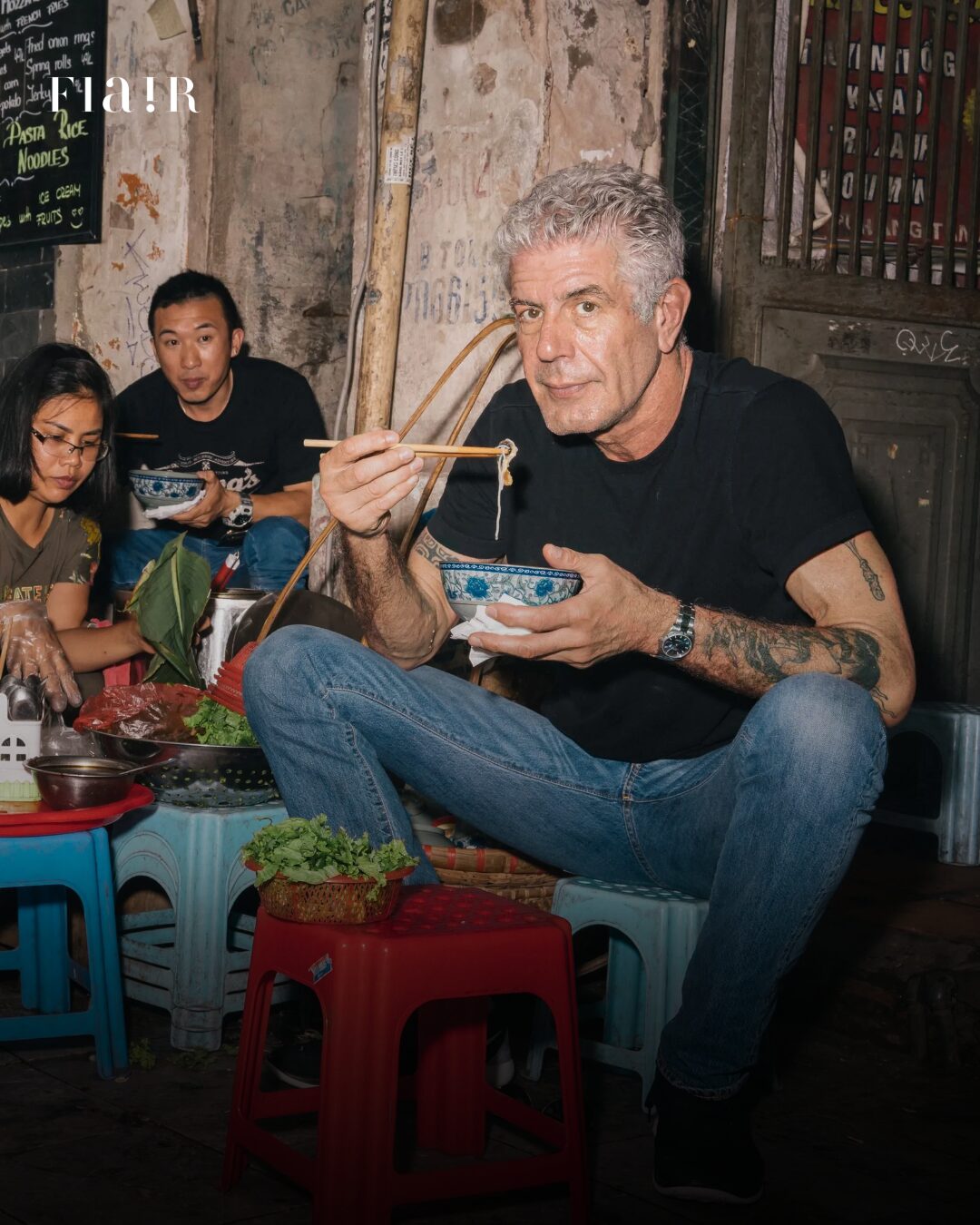
 The best meals of your life will almost certainly be eaten on a plastic stool in the pouring rain. There is a kind of madness that overtakes a traveler when they realize they are willing to endure a fourteen-hour flight, three transit connections, and a soul-shattering case of jet lag just to eat a bowl of soup on a plastic stool in the rain. Most travel writing sells a clean, comfortable lie by promising white-tablecloth sanctuaries, curated wine lists, and pristine plates engineered to look good on a screen. But the dishes that alter your DNA rarely come with a reservation, a dining room, or a clean floor – they thrive in the smoke, the noise, and the grease of joints that couldn’t care less about tourist validation.
No one understood this better than the loved and late Anthony Bourdain. Before he changed the way we look at a menu and approached food, he was an exhausted, middle-aged line cook drowning in the high-stress, drug-fueled chaos of New York City kitchens. That changed in April 1999 when The New Yorker published his legendary, unsolicited essay, “Don’t Eat Before Reading This.” The piece blew open the doors of professional kitchens, laying bare the brutal hours and piratical subculture that defined his world. It quickly expanded into his breakout 2000 memoir, Kitchen Confidential: Adventures in the Culinary Underbelly, turning an obscure executive chef at Les Halles into an overnight literary celebrity.
That success launched a television career that redefined travel media forever. When CNN launched Parts Unknown in 2013, Bourdain took that same raw, unvarnished perspective and applied it to the world. He didn’t use the camera to host a sightseeing tour, rather he used food as a Trojan horse to explore geopolitics, historical trauma, and human survival in places most networks actively avoided. When he brought the show to Gaza in Season 2, he bypassed typical news talking points, choosing instead to join local fishermen on the beach, cook traditional Gazan dishes like fatit ajir and maqluba with author Laila El-Haddad and her family, and simply center the everyday humanity of Palestinians living under blockade.
To him, eating was an act of raw engagement rather than an escape from reality. As he famously observed in his essay, “good food, good eating, is all about blood and organs, cruelty and decay.” It was a reminder that the greatest culinary traditions aren’t born out of wealth, but out of necessity, thrift, and a refusal to waste a single scrap. Stepping off a plane meant dropping the illusion of control and embracing the friction of the unfamiliar – a sentiment he summed up in his 2006 book The Nasty Bits: “Travel changes you. As you move through this life and this world you change things slightly, you leave marks behind, however small. And in return, life – and travel – leaves marks on you. Most of the time, those marks – on your body or on your heart – are beautiful. Often, though, they hurt.”
If you are looking for reasons to pack a bag and head into your own parts unknown, these are the heavy, brazen, soul-cleaving dishes that leave those marks.
Sarawak Laksa at Choon Hui Cafe (Kuching, Malaysia)
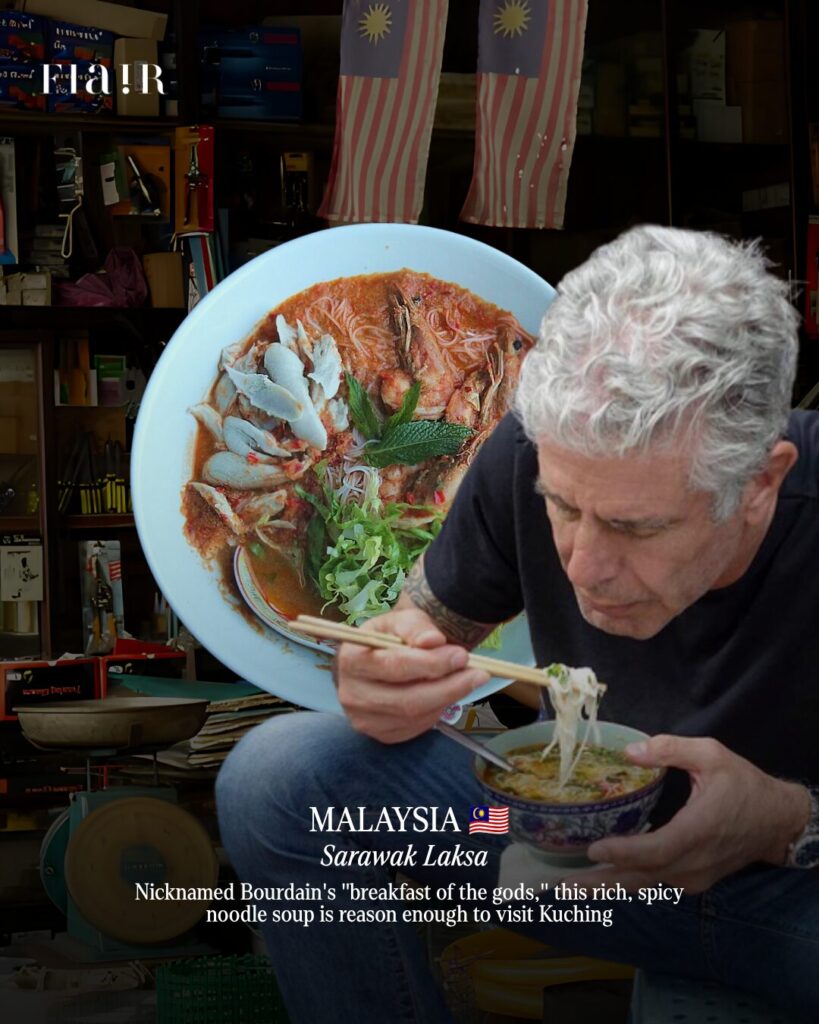
Southeast Asian noodle soups are often reduced to basic pho or standard red curry, but Sarawak Laksa operates in a league of its own. In Season 6 of Parts Unknown, Bourdain returned to Borneo and headed straight to Choon Hui Cafe in Kuching for a dish he famously crowned “the breakfast of the gods.” Unlike pork-heavy soups, Sarawak Laksa builds its depth on a complex paste of tamarind, galangal, lemongrass, and sambal simmered into a rich broth of coconut milk, chicken stock, and simmered prawn shells that are strained before serving. Ladled over rice vermicelli and topped with shredded poached chicken, boiled prawns, thin omelette strips, and cilantro, it is a sour, fiery, and deeply comforting bowl that makes morning jet lag instantly vanish.
Roasted Bone Marrow at St. John (London, England)
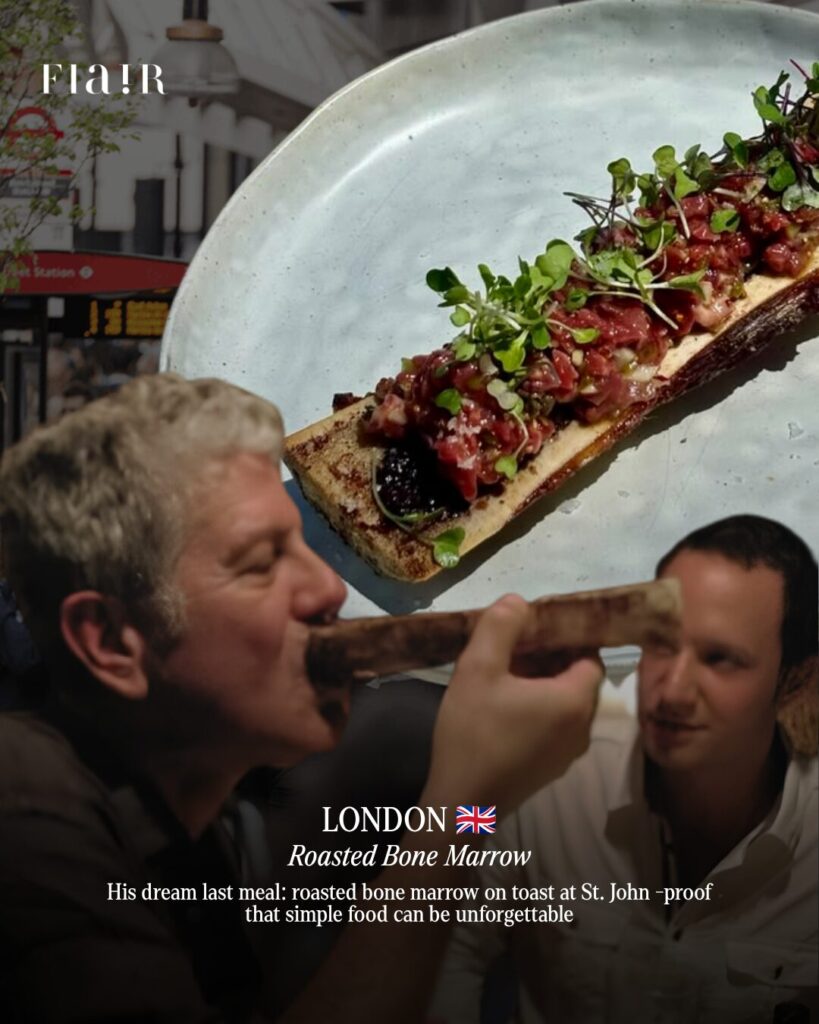
London’s food scene was once viewed with global skepticism until Chef Fergus Henderson opened St. John in Smithfield in 1994, stripping away every modern restaurant flourish to focus entirely on offal and nose-to-tail cooking. Bourdain featured Henderson and his philosophy across his series, famously naming St. John’s roasted bone marrow as his choice for his final meal on Earth. The dish has zero theater: just roasted veal leg bones served upright, a stark parsley, shallot, and caper salad to cut through the heavy fat, coarse sea salt, and toasted bread. You scrape the hot, rich marrow out of the bone with a tiny knife, pile it onto the bread, and eat it with your fingers. It’s elemental, heavy, and perfect – a complete rejection of tweezers and microgreens in favor of pure, unadulterated flavor.
Alleyway Yakitori & Conbini Egg Sandwiches (Tokyo, Japan)
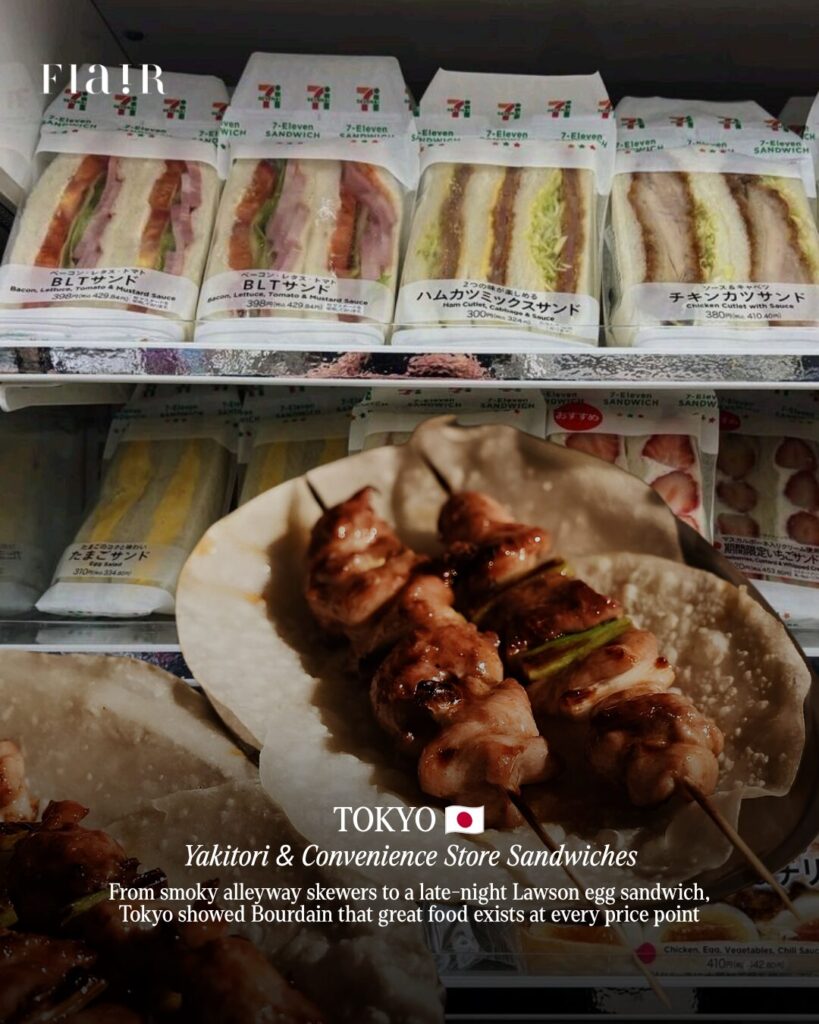
Tokyo exists on two extreme ends of a spectrum: hyper-obsessive culinary perfectionism on one side, and ultra-efficient street utility on the other. Throughout his work in Japan, Bourdain loved both with equal intensity. Down the narrow, smoke-filled alleyways of Omoide Yokocho (Memory Lane) under the train tracks of Shinjuku, tiny counter-only stalls grill chicken skewers over white-hot binchotan charcoal. Brushed with savory tare glaze or seasoned simply with sea salt, you eat hot yakitori alongside exhausted commuters as train wheels rumble overhead. Hours later, at two in the morning, you hit a local Lawson convenience store for an egg salad sandwich – crustless milk bread, rich egg yolk, and Kewpie mayonnaise. It sounds like simple comfort food until you eat one on a freezing Tokyo sidewalk and realize the Japanese have perfected convenience.
The Pintxos Crawl at Ganbara (San Sebastian, Spain)
In San Sebastian, eating is a mobile, high-energy affair where the entire city treats dinner as a rolling street party. San Sebastian’s Old Town is a dense grid of pintxos bars, each specializing in two or three specific bites displayed directly on the wooden counters. The method Bourdain championed on camera was simple: push your way through the packed crowd at Ganbara, order seared wild seasonal mushrooms (setas) topped with a rich, raw egg yolk, wash it down with a glass of high-poured Txakoli wine, throw your crumpled paper napkin directly on the floor, and leave. Ten minutes later, you do the exact same thing at the next counter down the street, letting the evening turn into a kinetic feast.
Mole Negro (Oaxaca, Mexico)
Treating Mexican food as merely quick or simple street food always drew Bourdain’s ire. In the Mexico episode of Parts Unknown, he used his platform to demonstrate that real Mexican cookery is as ancient, demanding, and historically dense as anything in global gastronomy. Oaxaca’s Mole Negro is the ultimate proof of that sophistication. The sauce requires days of grinding and simmering dozens of distinct ingredients – charred dried chilies, plantains, seeds, spices, and dark chocolate – until they fuse into a glossy, pitch-black sauce served over chicken or turkey. It’s savory, bitter, slightly sweet, and impossible to rush. That humble plate of mole in a humid market stall holds centuries of living history – and you taste every second of it.
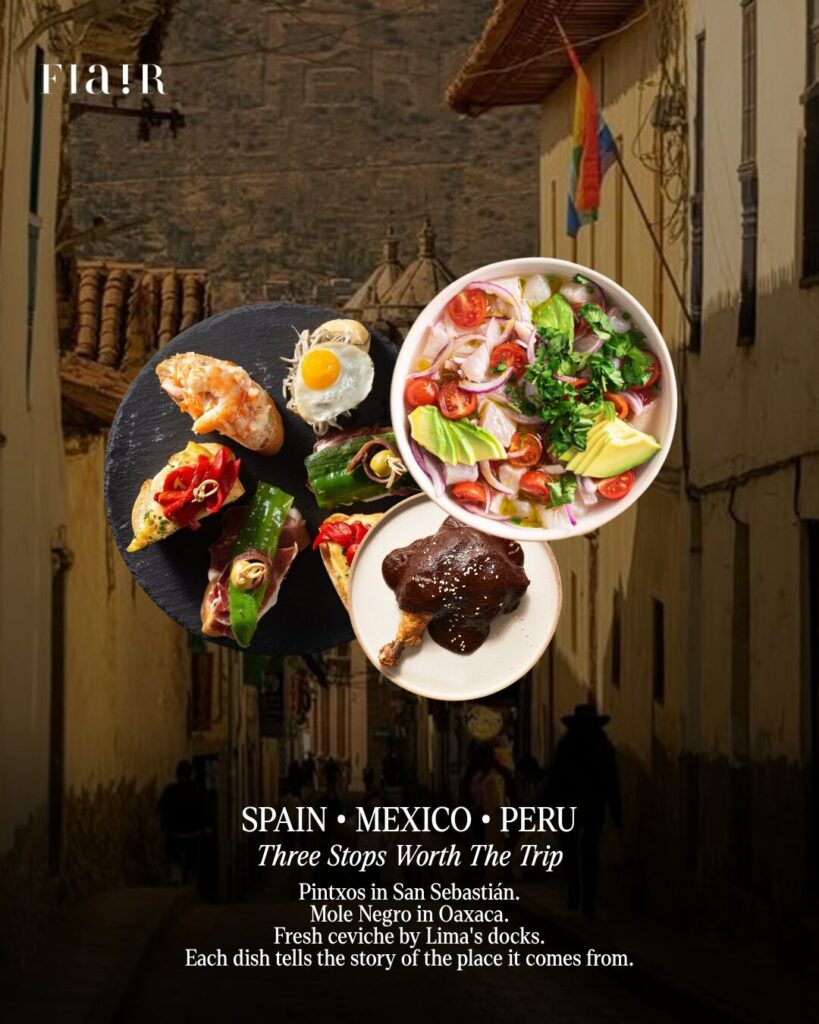
Ceviche at the Docks (Lima, Peru)
In the coastal districts of Lima, ceviche isn’t an appetizer brought out at dinner, but a timed morning event. Bourdain consistently highlighted the raw, uncompromising nature of Peruvian seafood culture, where eating raw fish after the morning catch has aged is considered an amateur mistake. At a bare-bones cevicheria near the fishing docks at noon, raw sea bass is flash-cured in pure, razor-sharp lime juice, tossed with red onions, cilantro, and fiery aji limo peppers. Served alongside cold sweet potato and massive kernels of choclo corn, the dish hits the palate like a shock to the nervous system. The leftover marinade – the leche de tigre, or tiger’s milk – is tossed back directly from the bowl like a shot. It is clean, bracingly acidic, and entirely dependent on the fresh catch of that exact morning.
Hainanese Chicken Rice (Singapore)
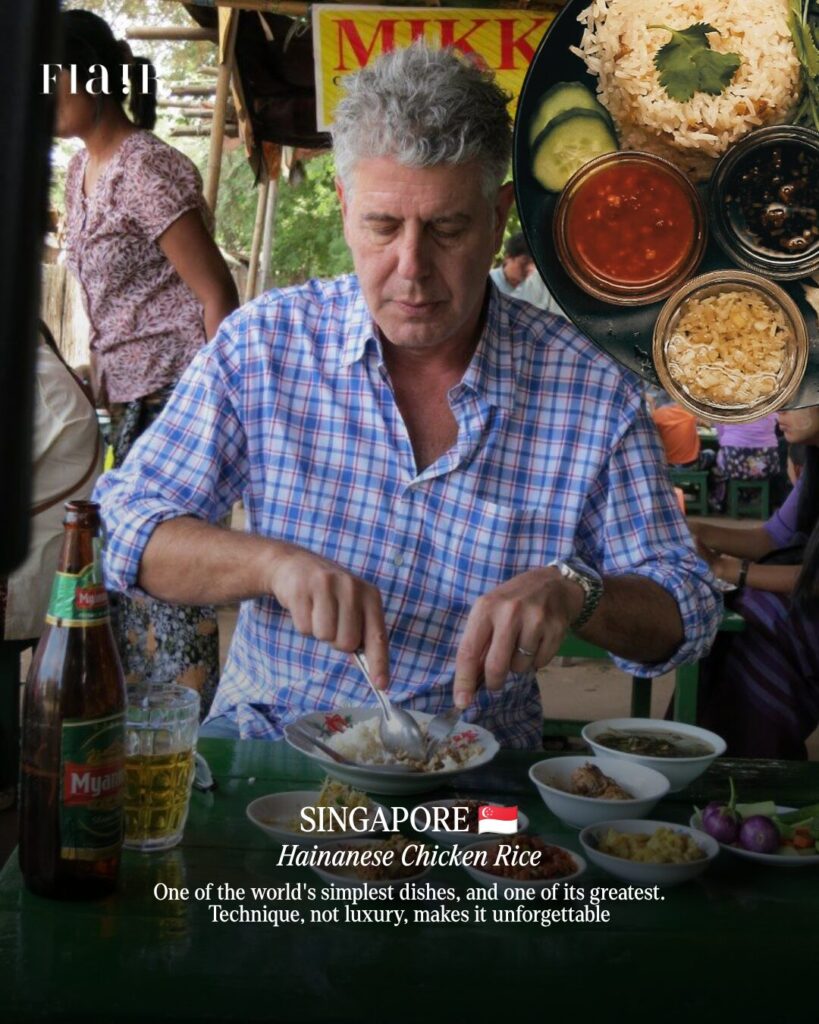
On paper, Hainanese Chicken Rice looks almost deceivingly simple: poached chicken served alongside white rice and a trio of dipping sauces. But in the bustling hawker centers of Singapore, it is treated with absolute reverence. In Season 10 of Parts Unknown, Bourdain highlighted Singapore’s open-air hawker stalls as one of the culinary capitals of the world. Whole chickens are gently poached until tender, then plunged into ice water to seal in the juices and form a delicate, gelatinous skin. The rice is cooked in rich chicken fat, garlic, ginger, and pandan leaves, turning every grain into a savory, aromatic bite. Served with freshly grated chili sauce, ginger paste, and dark sweet soy, it is universally accessible, deeply comforting, and proof that true street food perfection doesn’t require complexity – just flawless technique.
So whether you’re braving a bustling market, sitting at a noisy counter in an alleyway, or just grabbing a quick bite down the street, the true spirit of travel lies in letting go of the script. As Bourdain put it best: “Be open to experience, be willing to try new things, don’t have a rigid plan, accept random acts of hospitality without judgment or fear. Don’t be afraid to wander, don’t be afraid to eat a bad meal. If you don’t risk the bad meal, you’ll never get the magical one.”
Take his journey to Egypt, where he deliberately bypassed the tour bus crowds at the Pyramids to dive straight into the heart of daily life. From eating a simple street-side plate of foul from arabeyet foul for breakfast in Ataba to sharing a towering bowl of koshari at Abou Tarek and gathering around a subterranean sand pit with Bedouins in the Western Desert, he proved that the real soul of a destination is always found where people gather to eat.
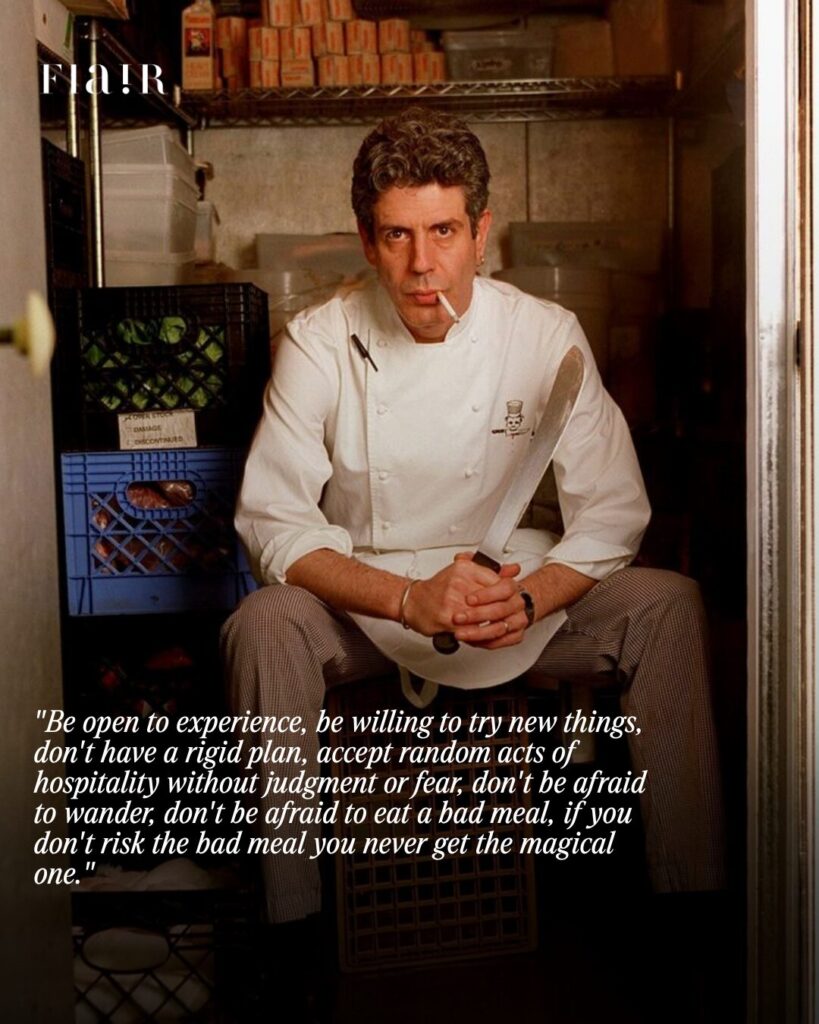
And that is how we should remember Anthony Bourdain. Don’t dwell on how his story ended, but honor how vibrantly, fiercely, and generously he lived it. Remember the sharp wit, the endless empathy, the insatiable appetite for life, and the way he made us all want to be braver humans and better guests in this world.
So pull up a stool, order something unfamiliar, raise a glass to the man who showed us how to travel and live with an open heart – and pour one out for Tony.