 Yara Lotfy
 Jewelry has long been a language of memory, a way of carrying stories, places, and identities close to the skin. For Noor Fares, founder of Noor Fares Jewellery, however, it is something even more profound—a dialogue between worlds. Raised between the vibrant landscapes of Lebanon, the artistic elegance of France, and the creative pulse of London, Fares has spent the past decade translating spirituality, architecture, and ancient symbolism into contemporary heirlooms. Her creations do not simply adorn; they invite reflection. Across collections such as Prana, Khandha, and INAYAT, each piece exists at the intersection of heritage and modernity.
In conversation with Flair Magazine, Fares reflects on the places that continue to shape her imagination, the memories that quietly endure across continents, and the belief that jewelry possesses a rare power—not to tell us who to become, but to remind us of who we have always been.
Having grown up between Lebanon, France and London, how has living between cultures shaped your creative language? Is there one place that still feels like the emotional center of your work?
Growing up between Lebanon, France, and London, has shaped the way I create. Each place has given me something different;
Lebanon instilled a deep appreciation for symbolism, hospitality, craftsmanship, and the richness of cultural traditions. France nurtured my love of art, design, and museums, while London exposed me to an incredibly diverse creative community and a constant exchange of ideas and perspectives.
If there is one place that remains the emotional center of my work, it is Lebanon. It is where I am from, and I find myself continuously returning to its landscapes, architecture, history, and the warmth of its people. Those memories and emotions are woven into my collections, even when they are expressed in a contemporary way.
Jaipur also holds a very special place in my creative journey. Although I have never lived there, I travel there regularly and work closely with the extraordinary artisans who bring my pieces to life. The city’s exceptional craftsmanship, vibrant colors, and centuries-old traditions have become an essential part of my creative process and continue to inspire me with every visit.
Your work often draws from cultures, philosophies and sacred traditions that span continents. How do you navigate the balance between honoring these influences and transforming them into something distinctly your own?
It always begins with learning. I spend time understanding the history, symbolism, and philosophy behind the traditions that inspire me, often through my travels and research. Those influences become a foundation rather than something to replicate.
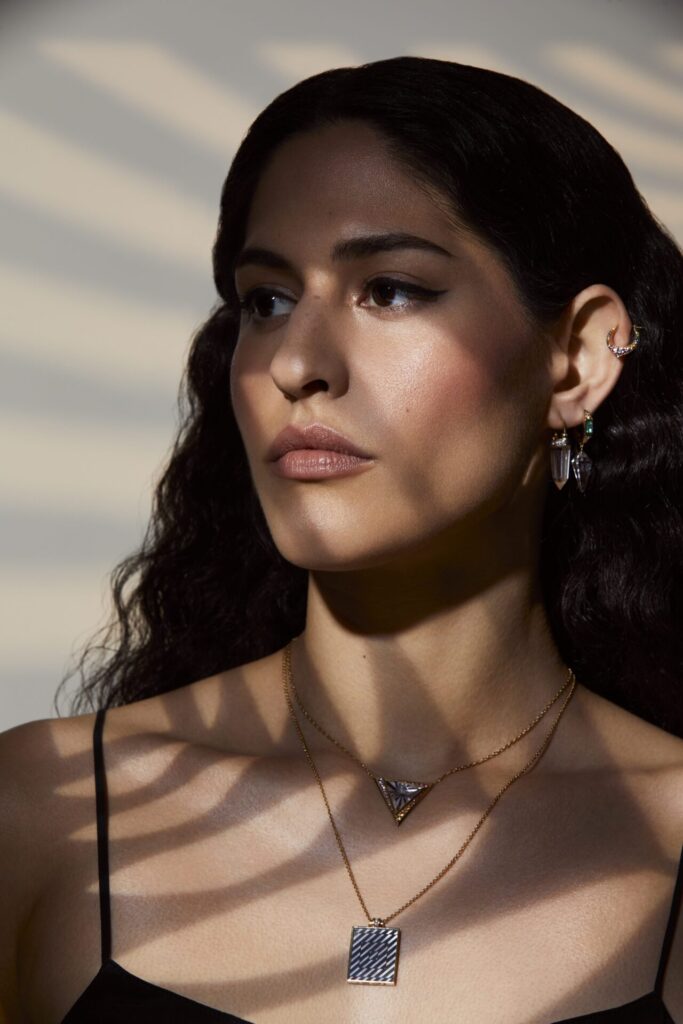
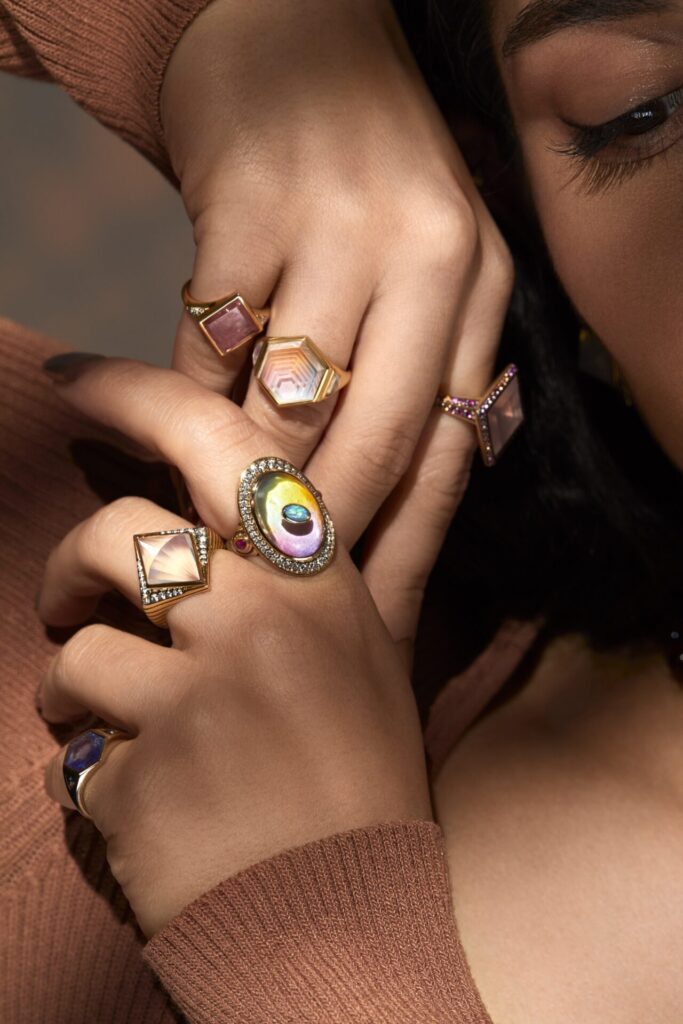
From there, I translate them into my own design language through jewelry, using geometry, color, and gemstones whose symbolism resonates with the ideas behind each collection. While certain forms may reference these traditions, the final pieces are always an interpretation that feels true to my own creative vision.
Your latest work embraces Arabic calligraphy in a particularly personal way. What inspired you to translate language into jewelry, and what emotions were you hoping to preserve through these pieces?
Inayat is deeply inspired by Sufism, Islamic art, and architecture, so incorporating Arabic calligraphy felt like a natural evolution of the collection. I’ve always been drawn to the beauty and expressive nature of Arabic script, and I had long wanted to integrate it into my work.
Collaborating with Farah Behbehani made the vision possible. I’ve admired her work for years, and it was fascinating to see her calligraphy translated onto such an intimate scale in jewelry. Her contribution became an integral part of the collection, and I loved seeing our two creative worlds come together to create something that is both meaningful and deeply personal.
The INAYAT collection launches at a moment when Arab craftsmanship and creativity are gaining unprecedented global attention. Do you feel a responsibility to represent the region through your work, or do you prefer to let the jewelry speak beyond geography?
I think it’s a bit of both. Being from the region, drawing from its history, craftsmanship, and culture, comes very naturally to me. It’s not something I feel obligated to do, it simply reflects who I am and what inspires me.
At the same time, I do feel a responsibility to highlight the incredible creativity and craftsmanship that exist across the Arab world. There is so much beauty, artistry, and heritage that deserves to be celebrated beyond the headlines people often associate with the region. And while those roots are central to my work, I also love that jewelry can speak beyond geography and resonate with people in unexpected ways.
Your collaboration with the Kuwaiti calligrapher Farah Behbehani is built on a dialogue between two artistic languages. What surprised you most about working with an artist whose medium is words rather than gemstones?
What surprised me the most was seeing how beautifully Farah adapted her work to such an intimate scale. She’s used to creating calligraphy on much larger surfaces, so watching her translate that same elegance and precision into jewelry was fascinating.
I also loved discovering how many different compositions and expressions could emerge from a single word. Each word we chose carries a beautiful meaning, and pairing those with carefully selected gemstones created a dialogue where the symbolism of the script and the stones naturally complemented one another.
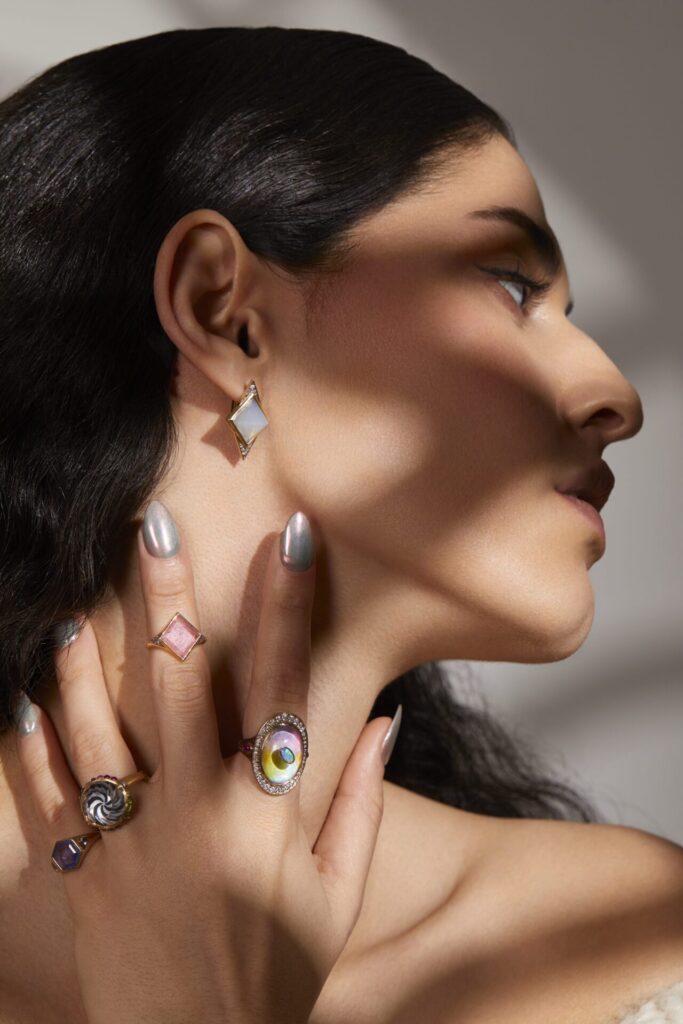
Working with your close friend Racil Chalhoub allowed your signature aesthetic to move beyond jewelry and into fashion. What did this collaboration reveal about your creative language when expressed through an entirely different medium? What did it teach you about proportion, movement and silhouette?
Working with Racil felt incredibly natural because we’ve known each other for so long, share similar values, and come from the same part of the world. I’ve always loved her tailoring and wear her pieces often, so there was already a strong creative understanding between us.
What I found most interesting was designing the gemstone buttons. It was exciting to see how the materials and craftsmanship I usually associate with jewelry could take on a completely different role within fashion. It reinforced the idea that gemstones can live beyond jewelry and become part of a garment’s silhouette and movement in a subtle but meaningful way.
Looking across collections like Prana, Prisma, Krystallos, Khandha and now INAYAT, there is a clear evolution in your storytelling. Do you see each collection as a standalone chapter, or are they all part of one continuous narrative you’ve been writing since 2009?
I see them as part of one continuous story. Each collection reflects where I am at a particular moment in my life, evolving alongside my travels, experiences, and the things I’m learning.
While every collection has its own identity, they are all connected; I often find myself building on ideas from previous collections, refining them and giving them new meaning as I grow. Looking back, you can trace that evolution, so rather than standalone chapters, they feel like different moments within the same ongoing narrative.
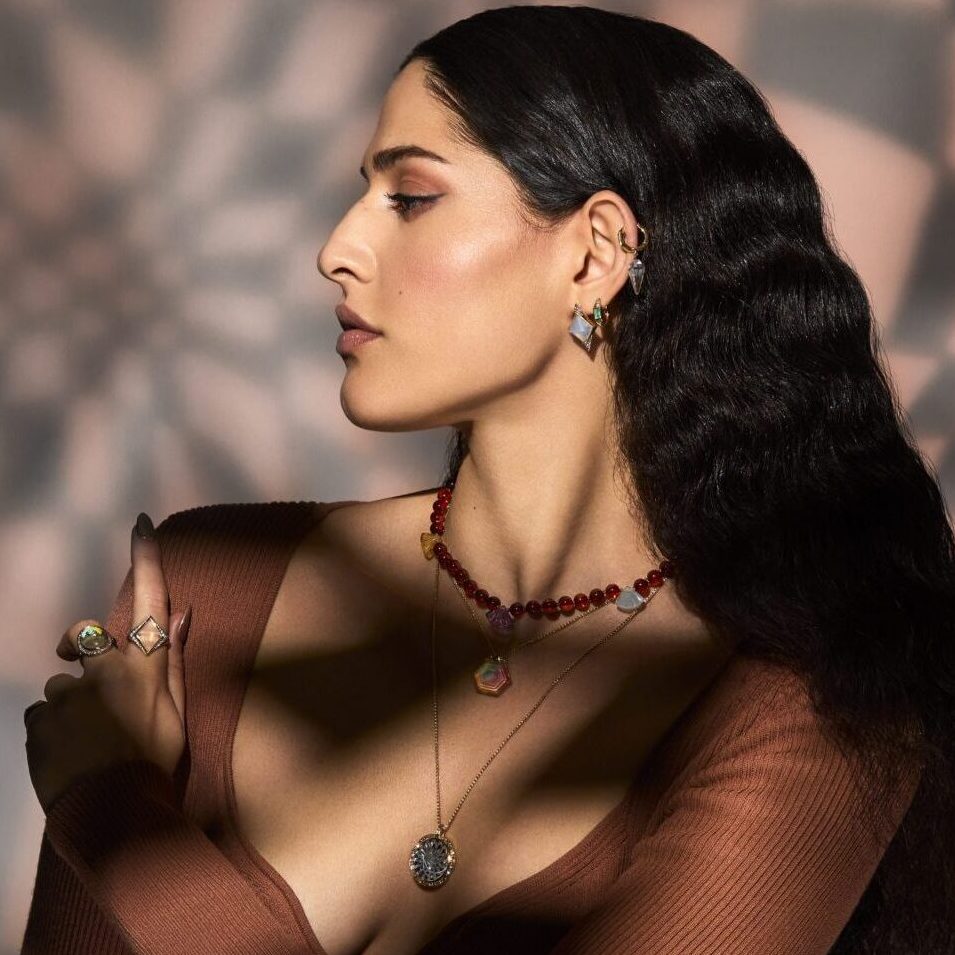
After exploring architecture, spirituality, crystals, color, calligraphy and philosophy, where do you feel your creative curiosity is pulling you next? Is there a subject you haven’t yet translated into jewelry?
My curiosity is always evolving. Every journey, every place, and every encounter leaves me with new ideas, and I have endless things I’d love to experiment with. There are still so many worlds I’d like to explore creatively, but I’ll keep the next chapter a surprise for now.
Fashion often asks us who we want to become, while jewelry has the power to remind us of who we already are. When a women wears a Noor Fares creation, what do you hope they discover about themselves?
I hope they feel a sense of protection, hope, and light. I want each piece to become part of their own story, carrying a meaning that feels personal to them. Whether it’s through color, stacking, or symbolism, I hope my jewelry reminds people of something timeless within themselves.
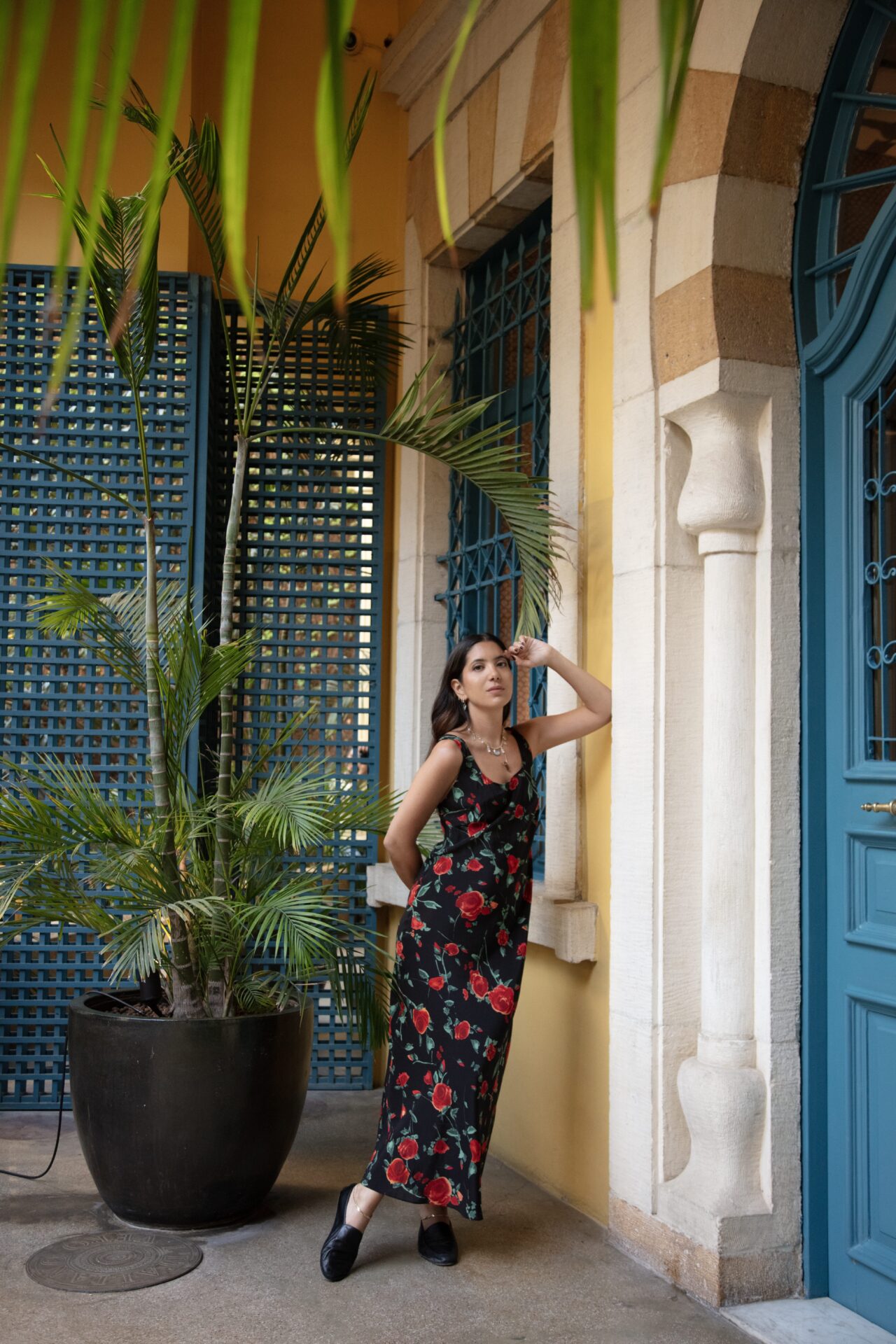
Pictured in the featured image is Noor Fares, founder of Noor Fares Jewellery. Image courtesy of Tarek Moukaddem.