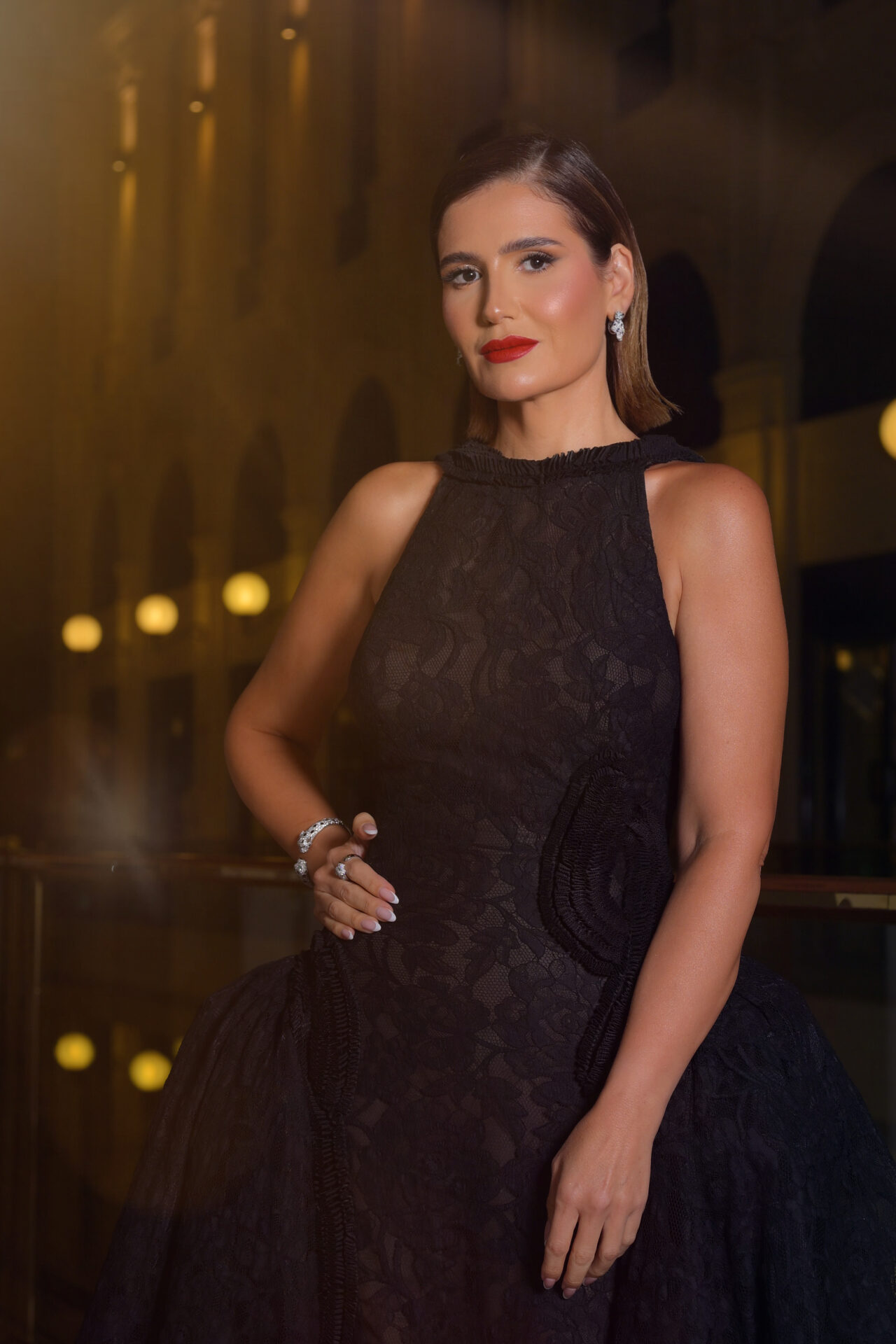
 Hedayat Reda
 In an industry obsessed with scale—longer runtimes, bigger budgets, wider releases—the short film remains cinema’s most underestimated form. But if you ask Hana Shiha, that’s precisely where its power lies.
“Cinema is the mirror of society,” she says, with the clarity of someone who has spent years navigating both its surface and its depths. And sometimes, that mirror doesn’t need two hours. Sometimes, it only needs fifteen minutes.
The Case For Less
As anticipation builds for the 12th edition of the Alexandria Short Film Festival (ASFF), Shiha is not just attending the festival—she’s helping shape its future. As a member of the festival’s advisory board, alongside names like Yousry Nasrallah and Enas Abdeldayem, her role extends beyond presence into advocacy.
Founded in 2015 by the Alexandria Art Circle Association, ASFF began as a national initiative and has since evolved into an international platform—now one of only two Oscar-qualifying festivals in Egypt, alongside the Cairo International Film Festival. Its mission is deceptively simple: to develop and elevate short-form cinema, while creating a space for filmmakers across the world to exchange ideas.
Yet despite its global recognition, Shiha believes the festival still lacks the visibility it deserves—particularly in Cairo. “It’s already important,” she notes. “It just needs more eyes on it.”
What is a Short Film?
A short film, by ASFF standards, runs anywhere between 6 to 30 minutes. But don’t mistake brevity for simplicity.
“In many ways, it’s much harder than a feature,” Shiha explains. “You have less time to build a world, a character, a message—and still make it land.”
This compression is exactly what draws her to the format. “If I can tell the story in 15 minutes and it delivers, I’m happy. Short films go straight to the heart.”
The festival reflects that diversity of storytelling through its categories—spanning narrative fiction, documentary, and animation—each judged by international juries and culminating in awards like the Golden and Silver Hypatia, named after the ancient Platonic philosopher Hypatia.
A Personal Investment
Shiha’s commitment to short films isn’t theoretical—it’s personal. The daughter of renowned artist Ahmed Shiha, she entered the industry with a natural affinity for performance, building a career across both television and cinema. Her filmography spans commercial successes and more introspective roles, from early appearances in Egyptian cinema such as Hob El Banat to more recent, character-driven work.
Through her production house, AHM Production, she has actively worked to bring unconventional stories to life, while also exploring new financing models like brand integration and sponsorship acquisition in cinema—an approach she helped introduce to the Egyptian market.
This year, she arrives at ASFF with 32B, a short film that has already garnered international acclaim, winning Best Film in Tunis and earning a rare nomination for the Tribeca Film Festival—a first for an Egyptian short.
The film, which will premiere in Egypt at the festival’s opening, is deceptively quiet. It centers on a father navigating a delicate, often unspoken milestone in his daughter’s life: her coming of age, and the awkward, tender conversation around wearing a bra.
Backed by the United Nations Population Fund (UNFPA), the film aims to normalize discussions around menstrual and adolescent health.
“How do we talk about important things without saying them outright?” Shiha asks. “Cinema allows that.”
The Actor’s Challenge
For Shiha, short films are not just a narrative experiment—they are an acting crucible.
“In 32B, I have one scene,” she says. “But in that one scene, you need to understand who I am, why I’m there, what I want.”
There is no time for gradual character development. Everything—motivation, history, emotional weight—must be conveyed through physicality, tone, and presence. “It requires much deeper digging,” she explains. “You’re building a full character in fragments.”
“Meen Madame Noura?” She asked herself and her team millions of times during filming and prep in order to strip her character down to her essentials.
In a film where she appears in a single, concentrated moment, the answer must be felt instantly.
Beyond the Screen
ASFF’s ambitions extend beyond screenings. Over its six-day run, the festival hosts panels, workshops, and conversations—this year including collaborations with Drosos Foundation, which is leading workshops for children and people with disabilities, teaching them how to use their phones as tools for filmmaking rather than passive scrolling.
The festival also brings together a notable jury. The international competition panel includes Mohamed Hefzy, Kamel El Basha, Mervat Abou Ouf, Jaume Quiles, and Rakeen Saad—a cross-regional lens on storytelling that reflects the festival’s growing global reach.
On screen, this year’s program travels just as widely. Among the featured films are the German production Ceremony by Mark Wachholz, the French short Tied, and the Chinese film The Greedy Nightmare, —a lineup that underscores the festival’s commitment to international dialogue through cinema.
Notable cinematic figures from across the cinematic spectrum will also be honored including actor Essam Omar, Palestinian director and cinematographer Ahmed El Danaf, editor Mona Rabie, and director Maha El Shennawy—an acknowledgment that cinema is, above all, a collective
A Cultural Reset
In a region where the film industry often gravitates toward commercial formulas, short films offer something radical: freedom.
They are less constrained by box office expectations, more open to experimentation, and uniquely suited to tackling sensitive or unconventional themes. For Shiha—who has also used her platform to support initiatives like Sudanese refugee awareness campaigns and global conversations on women in cinema—this matters.
“Cinema is the easiest way to say what you want,” she says. “And short films let you say it faster.”
Catch Hana at ASFF in her panel with the UNFPA or at Cannes May 12th and 13th where she will be discussing the future of women in film and media with the World Women Fund.