 Hedayat Reda
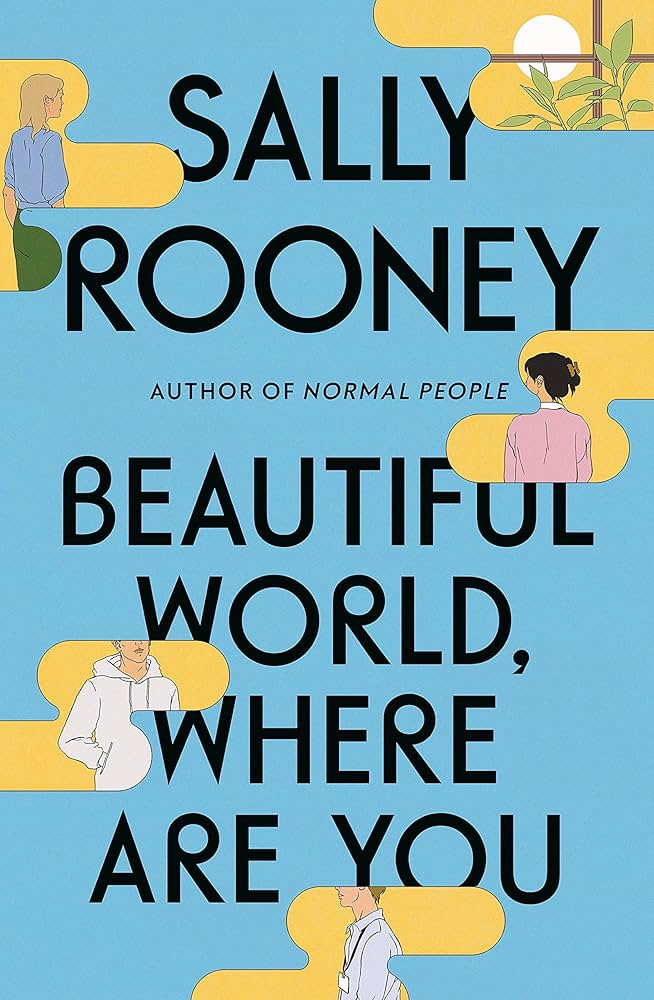
 The master of emotions and depth in contemporary fiction appears again in the most transcendent, thought-provoking way—bringing smiles, laughter, and the occasional tear to our eyes. We may be a bit late to the game, but Sally Rooney’s Beautiful World, Where Are You? is not. A force in its literary prowess, a mover of worlds—interior and exterior—this novel is not just experienced, but remembered, again and again.
“Maybe we’re just born to love and worry about the people we know, and to go on loving and worrying even when there are more important things we should be doing. And if that means the human species is going to die out, isn’t it in a way a nice reason to die out, the nicest reason you can imagine? Because when we should have been reorganising the distribution of the world’s resources and transitioning collectively to a sustainable economic model, we were worrying about sex and friendship instead. Because we loved each other too much and found each other too interesting. And I love that about humanity, and in fact it’s the very reason I root for us to survive—because we are so stupid about each other.”
If you’ve never read a Sally Rooney novel, it’s difficult to prepare you for the experience. It is harrowing, mind-altering, and at once perplexing and deeply moving. In Rooney’s world, characters are the center of all happenings and the true axis of every story she tells, regardless of plot. A master of dialogue and truth delivered in the most profound ways, this Irish prodigy weaves stories in layers and fragments, gradually unmasking humanity at its core.
In Beautiful World, Where Are You?, two best friends, Alice and Eileen, embark on separate yet parallel paths. Alice is a successful novelist recovering from a major breakdown, renting a house in the Irish countryside where she meets Felix, a warehouse worker she impulsively invites to travel with her. Eileen, working quietly at a literary magazine in Dublin, slips back into a complicated, slow-burn connection with her longtime friend Simon.
The novel unfolds across two planes: a third-person narrative that moves between characters’ perspectives, and an epistolary format through emails exchanged between Alice and Eileen—the emotional backbone of the story.
What begins as a tale of friendship and romance gradually evolves into a profound critique of society and class, alongside a nuanced portrayal of attraction, emotional vulnerability, and the space between action and interpretation.
The correspondence between the two women is particularly fascinating—a striking blend of the personal and the philosophical. Their romantic entanglements—Alice navigating her impulsive attraction to Felix, Eileen cautiously reconnecting with Simon—are interwoven with reflections on the decline of civilization, Ireland’s landscapes, and the psychological burdens of modern life. At times, their thoughts and arguments can feel dense or challenging, but they are always instructive. Reading their emails makes you wonder why your own messages to friends don’t sound quite this alive.
What stands out most in this novel—and in Rooney’s writing overall—is its startling authenticity. No character is defined by a single trait. No one is polished into an ideal or behaves predictably. Felix, for example, can be abrasive and provocative, yet he reveals surprising vulnerability and insight in moments that catch both Alice and the reader off guard. The characters feel lived-in, contradictory, and fully formed in a way few authors achieve.
One notable technical choice is Rooney’s absence of quotation marks in dialogue. Initially disorienting, this stylistic decision ultimately adds intimacy, making conversations feel fluid and immediate—as though the reader is eavesdropping on thoughts as much as speech.
The novel leaves you with a kind of emotional hangover—uncovering the awkwardness and contradictions of life in subtle, compassionate ways, while offering a quietly hopeful take on relationships and honesty. It is an interpersonal journey built from fleeting moments, imagined scenarios, and raw emotion. Reading it feels like listening in on life itself—messy, intimate, and occasionally uncomfortable.
I’d give it a solid 4 out of 5 stars—because, let’s be honest, even near-perfection deserves a little wiggle room.