 Hedayat Reda
 In the quiet hum of the desert, amidst structures that have moved time, a new light emerges.
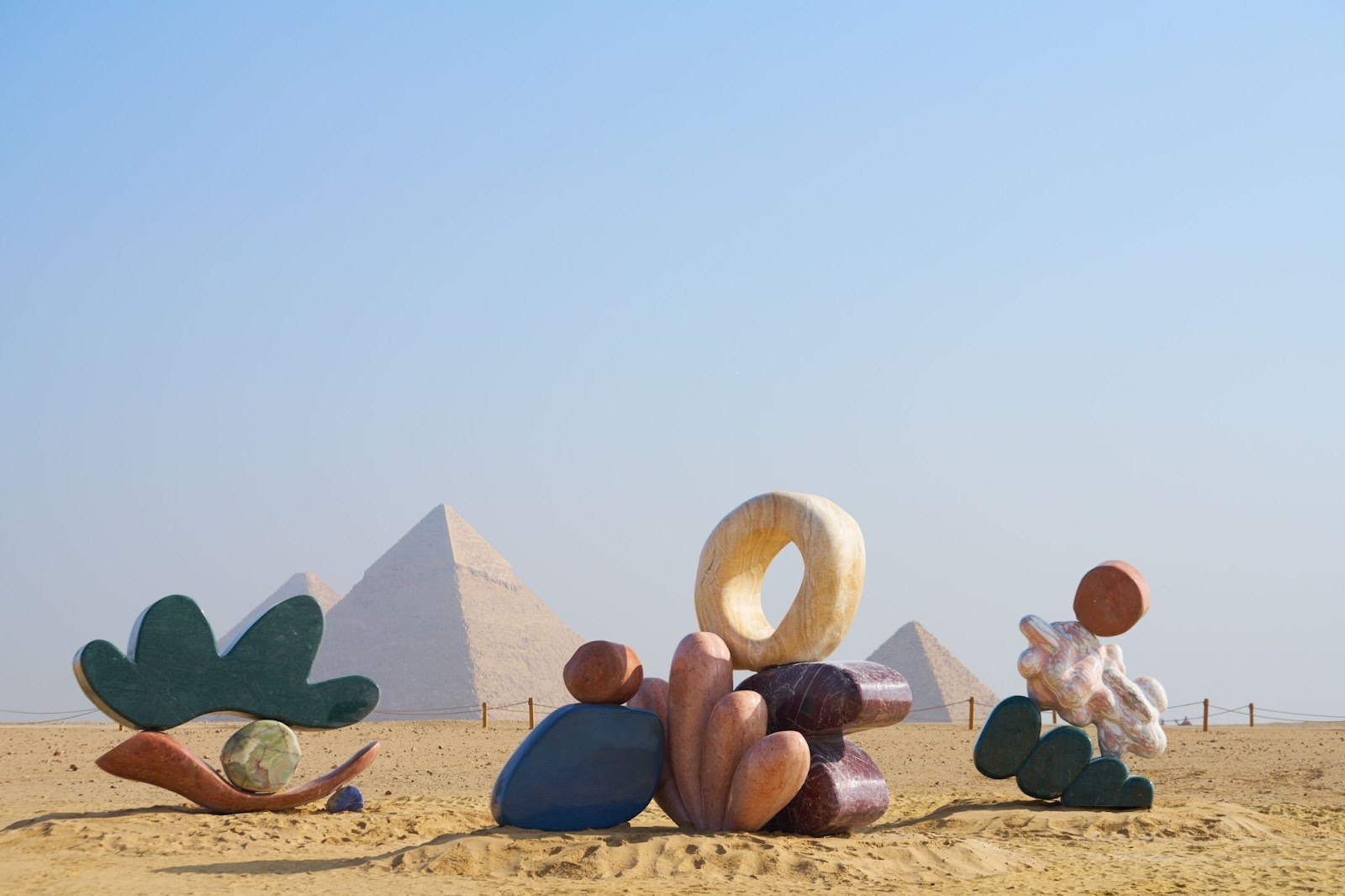
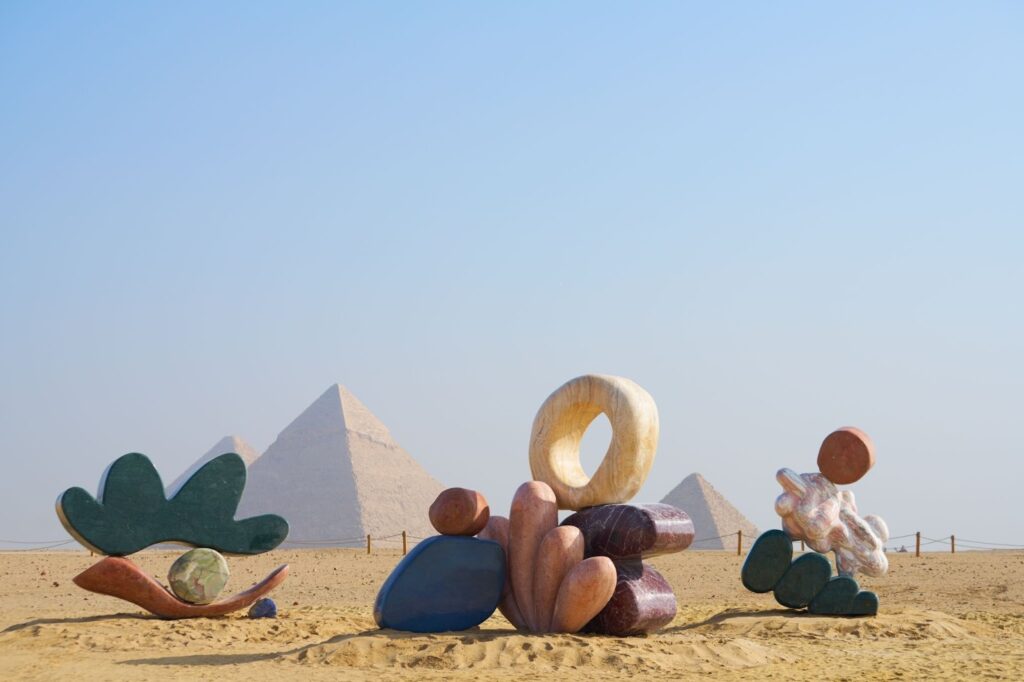
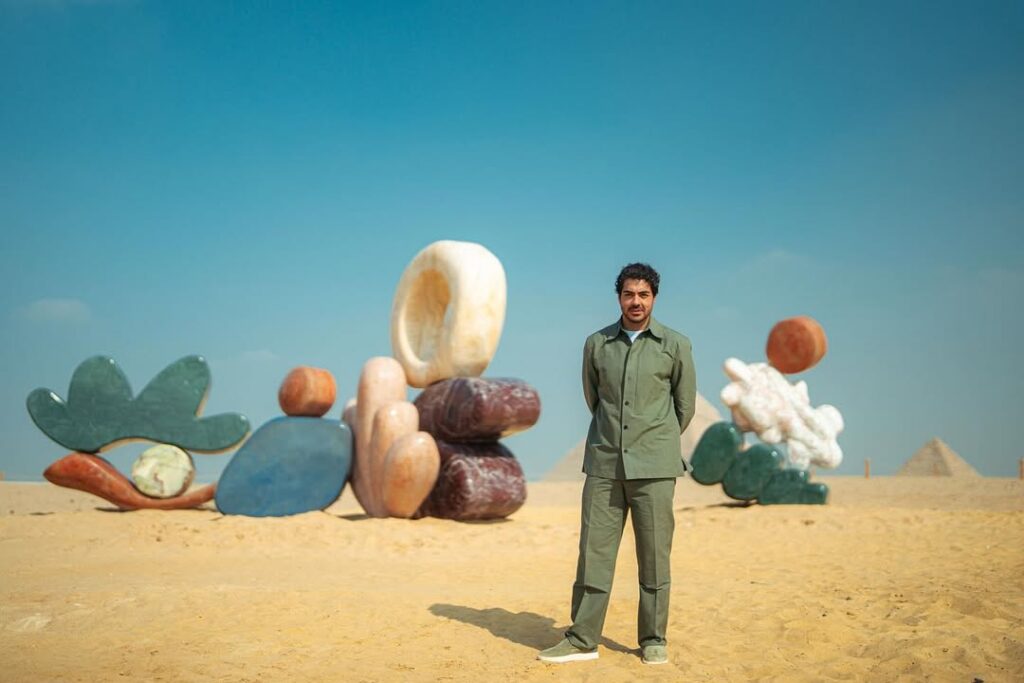
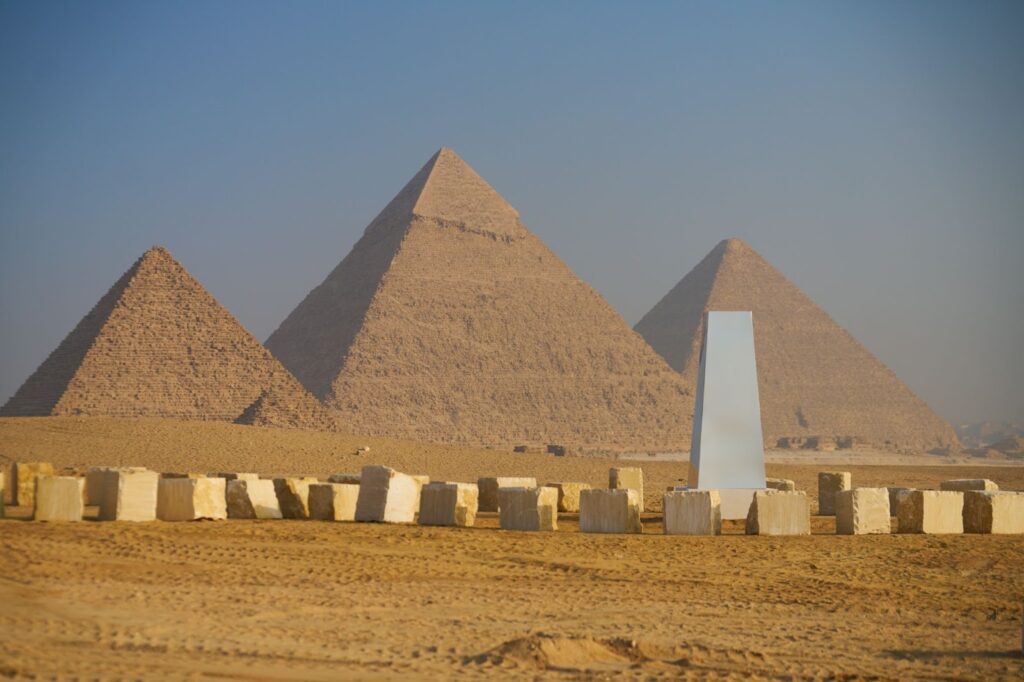
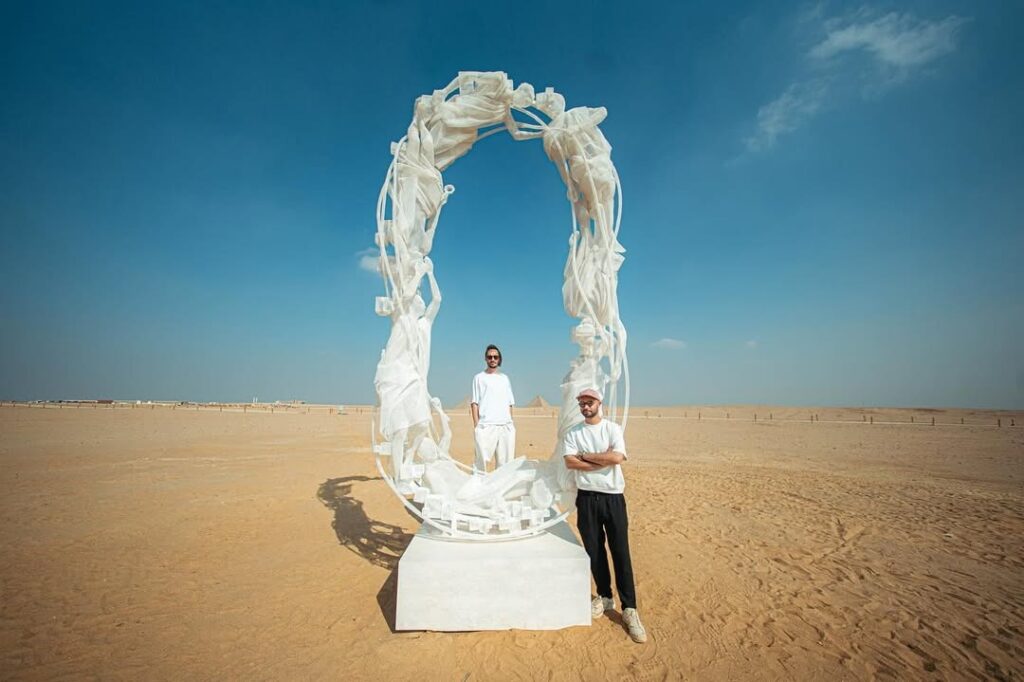
“A clash of different cultures brought together questions of why we do what we do and how we do it,” David Mahyari of SolidNature muses aloud to a small crowd, the sun strong against the solid rock shapes of ivory, rose, sage, cobalt, and terracotta that he stands propped against. As I look at the shapes emerging behind him—the beginning of an eye, a flower enveloped, a figure dancing—I am struck by the feeling of what it means to be solid. To act in a world where your very being can elicit movement.
ECHOES OF THE INFINITE- ALEX PROBA AND SOLIDNATURE
“The flow of materials questions how things have been done and how we are doing things. Stone is all formed at the same time; only this one behind me” —he gestures to the Pyramids— “has been touched by them (the Pharaohs), and this one” —the marble-like piece he has transported from overseas— “by us.”
I don’t need him to explain to me how stone is massive, that the material itself often dictates how the craftsman will utilize it and whether or not it will be a clean, unembellished piece or if the final product will be more opulent. But he does so all the same, with gusto—bringing sensitivity to a bold and ancient practice.
At this year’s Art d’Egypte: Forever is Now exhibit 10 artists from 10 different countries have been asked to dwell on the concept of immortality as well as the ideas of endurance and legacy: what do we leave behind?
“We started with the idea of three pyramids and making three different volumes. The first one is a take on the Eye of Horus, and this one here”—what I thought to be a flower—“is a kind of portal to the past.” His analysis makes me question the role of purpose, and to what extent an artist’s hands can change meaning across time. Also—more abstractly—what time means to us as humans in general. David is confident, friendly, and relaxed as he tells us about all of the production, transportation, and detail that has gone into bringing artist Alex Proba’s work to Egypt.
The solidness of a structure is not something that can be explained in words. It is something that can only be felt, and it is a theme that all of the works at this year’s Art d’Égypte: Forever is Now have in common.
DOORS OF CAIRO- ALEXANDRE FARTO (VHILS)
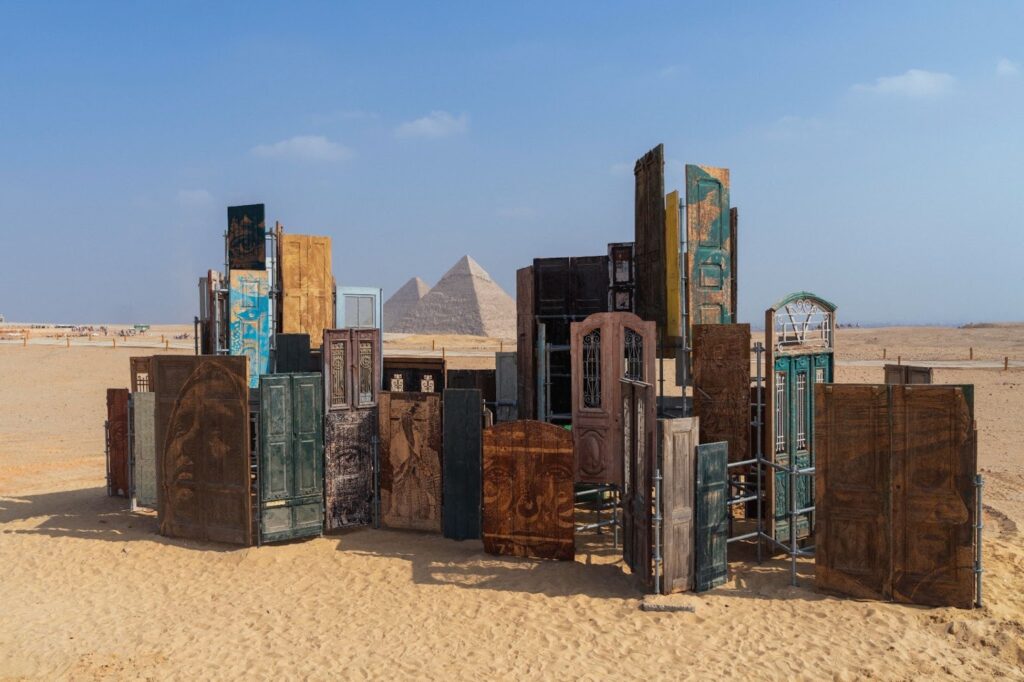
“Doors protect us, but you can also open a door to receive people.” Alexandre Farto (aka Vhils) receives us with a shy smile and a warm countenance. His labour of love, Doors of Cairo, encompasses 65 doors collected over six months from our gritty and electrifying streets. They form a network made up of different shapes and sizes propped together and connected by a pipe-like rod made of metal, then engraved with the artist’s signature carving technique.
“Are these hieroglyphs?” a member of the press asks him with interest, pointing at a large chestnut one—a piece of the façade that welcomes us.
Alex nods, explaining that the carvings feature different ancient and human scenes, and that this technique allows him to go to the bone of the piece, bringing out the natural paint that has been weathered by years of usage and thus bringing the image back to life. The role of memory in his piece is a constant one, exemplified in the living backdrop of the land, in the life that each door has borne witness to, in the created value of combining all of these parts to form a whole—and in us experiencing it right now.
WHITE TOTEM OF LIGHT- KING HOUNDEKPINKOU
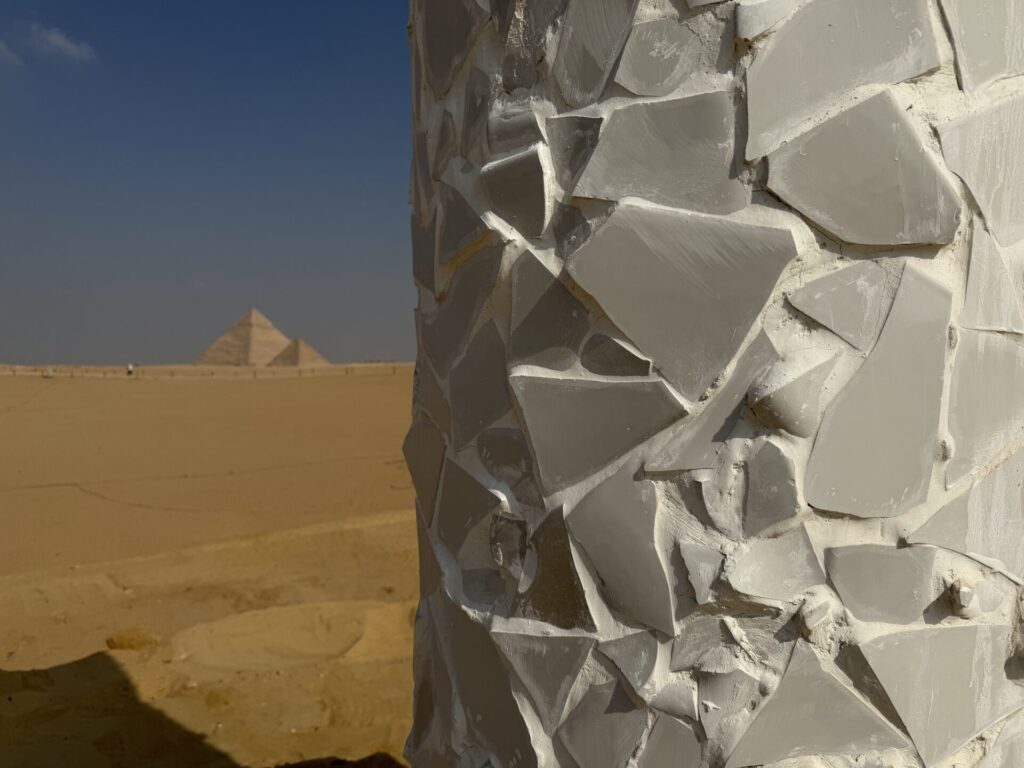
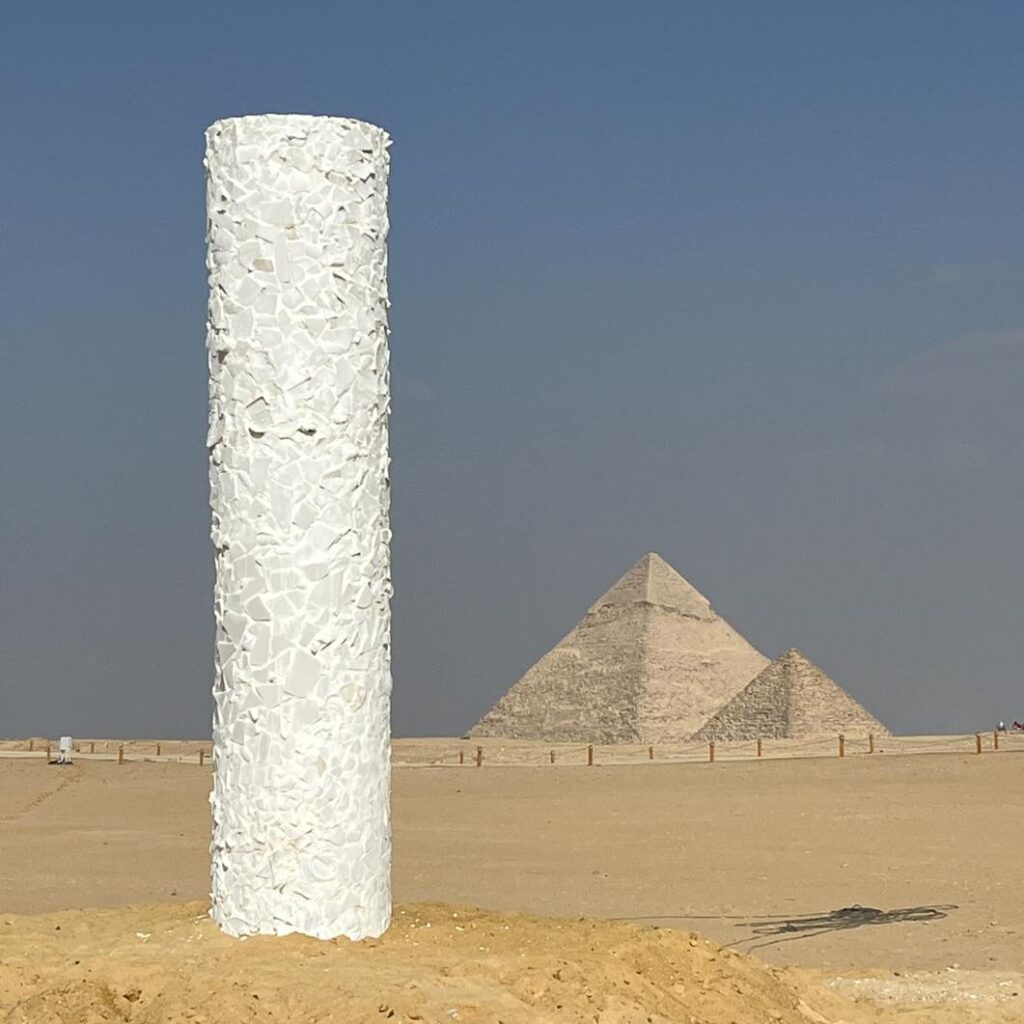
“My piece shattered in the kiln,” the slight and vibrant King Houndekpinkou points to his White Totem of Light. “I had a week to find a solution for the shattered piece.” A ceramicist by trade and a natural-born speaker at heart, King’s shining white tower aims to stand as a ray of light for all to see, both physically and metaphorically speaking.
“With what I went through last year in my personal life and in trying to rebuild myself, it makes this a very personal exhibit for me.”
Remade from the broken pieces and embellished with handmade patterns that are inspired by natural defense systems as well as the protective mechanisms found in flowers, plants, and other organic forms, the Totem of Light was assembled almost entirely on the Giza Plateau and encapsulates King’s mystical side and his belief in spirituality as a grounding force. An example of what it can look like to build yourself back together after being ‘broken,’ the tower, like the pyramids, has a centering power—one that is subtle yet profound. I think of a lighthouse guiding boats, the preservative power of an obelisk, or—more personally—the plants I have grown on my balcony in the past year.
WIND- ANA FERRARI
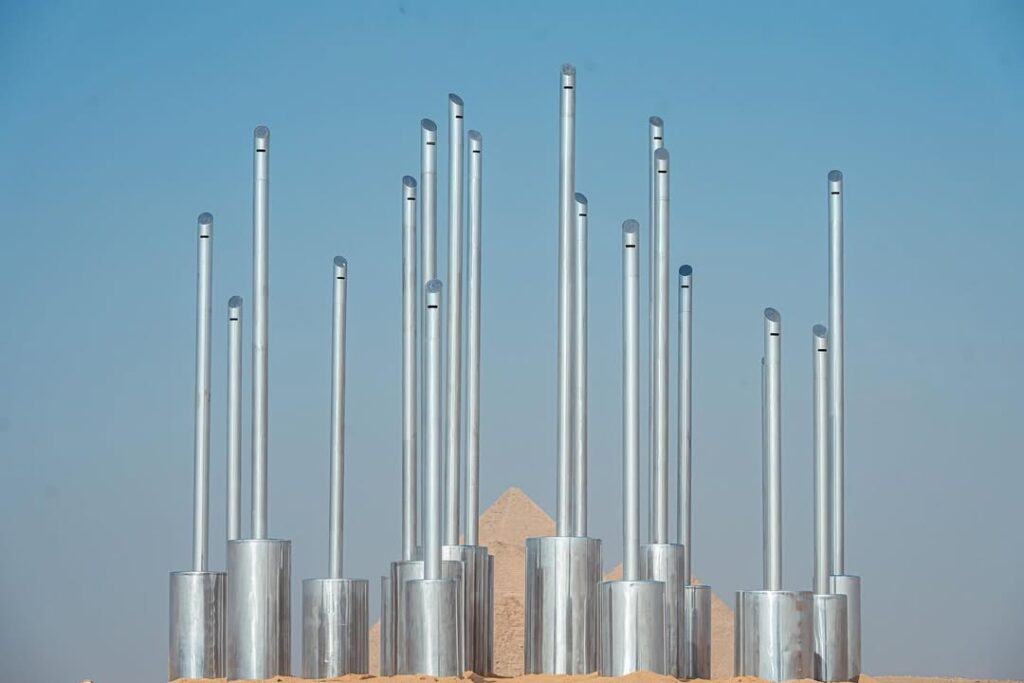
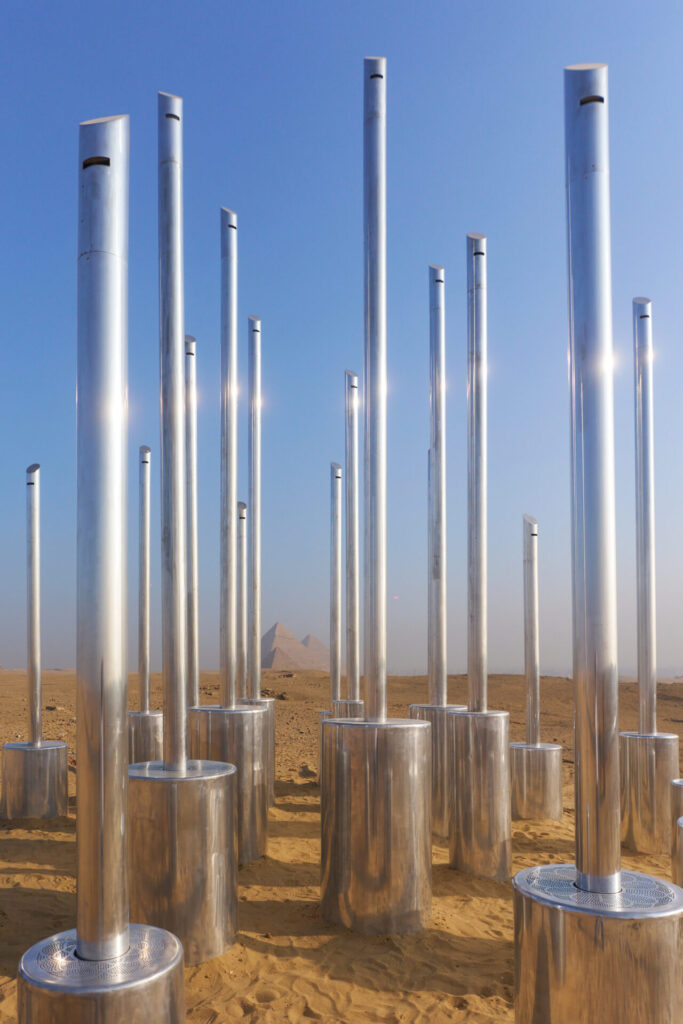
A few pieces after him, Ana stands charming and radiant amidst her silver flutes, calling upon us to listen. For a minute, the group of us journalists is overcome with a hush—similar to the second right before a film is about to be screened: excitement, anticipation, and a hint of caution go through us—until a light, bell-like toll whistles through.
Wind is a force, a study in sound and acoustics, and in Ana’s words “a collaboration with nature.” Comprising 21 large polished aluminum structures that come together in a spiral formation, Ana uses this piece to bring the invisible to the visible, mirroring ourselves in her artwork. As the wind blows through her piece, it vibrates. As we take part in nature, it moves. Solid, like all the pieces—purposeful.
DESERT FLOWERS- NADIM KARAM
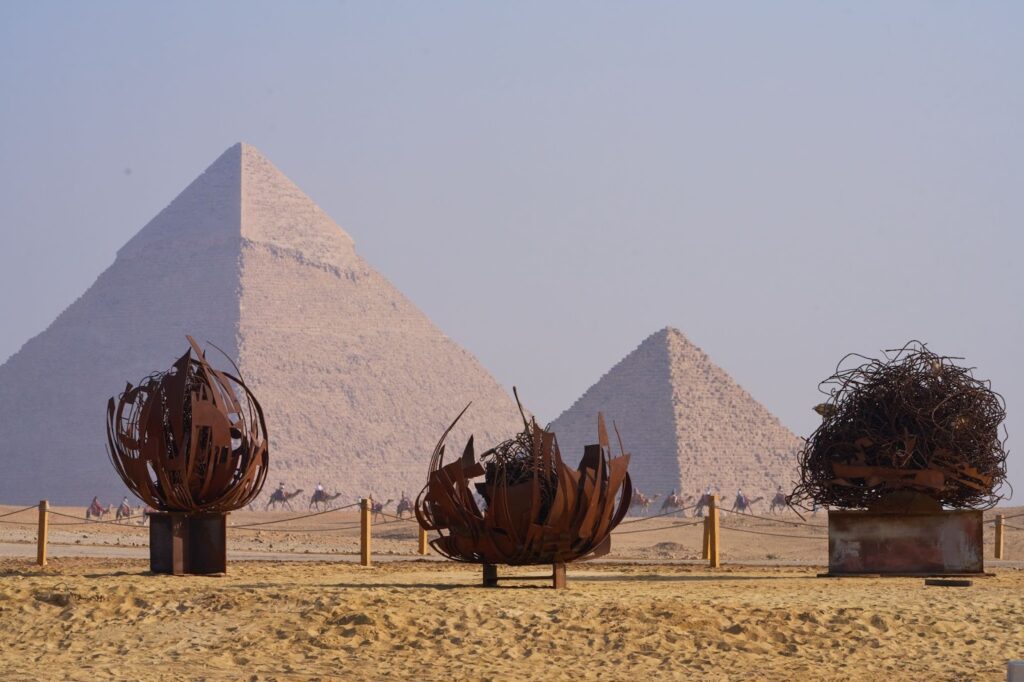
Nadim Karam’s Desert Flowers feel raw and energetic. Three bronze-coloured balls that tangle and twirl, they symbolize the journey of a lotus from Rebirth to Creation. As I take them in I see the closed bulb, the flowering plant and finally the bloom, a clear ode to the enduring kingdom behind them.
“With the sun they open again and show us beauty.” Nadim’s use of scrap is a medley into what is forgotten and what is remembered, a nod to the revivification of history as we know it.
MERT KÖSE- THE SCHEN
THE THIRD PARADISE-MICHAELANGELO PISTOLETTO NULL- RECYCLE GROUPE
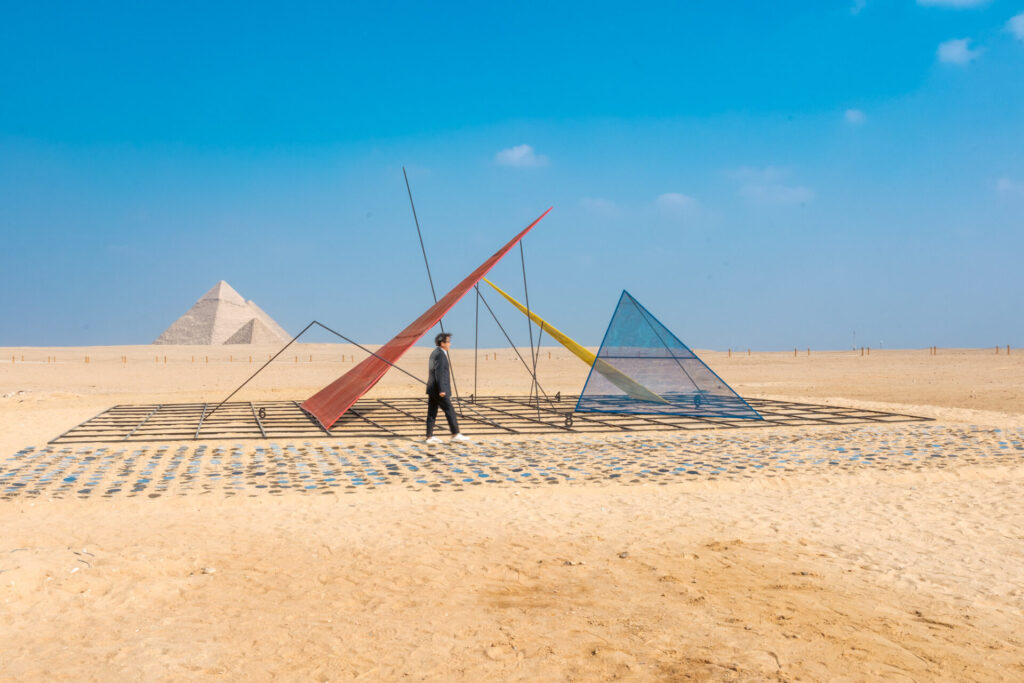
CODE OF THE ETERNAL- J.PARK
It is a feast for the eyes and a welcome journey for the heart to move through and between: Recycle Group’s experimental and multifaceted Null, Mert Köse’s shining The Shen, J. Park’s mathematical encryption genius in Code of the Eternal, Pistoletto’s sustainability marvel Third Paradise (a fusion of the natural and the created worlds), and finally to Salha Almasry’s foundational Ma’at.
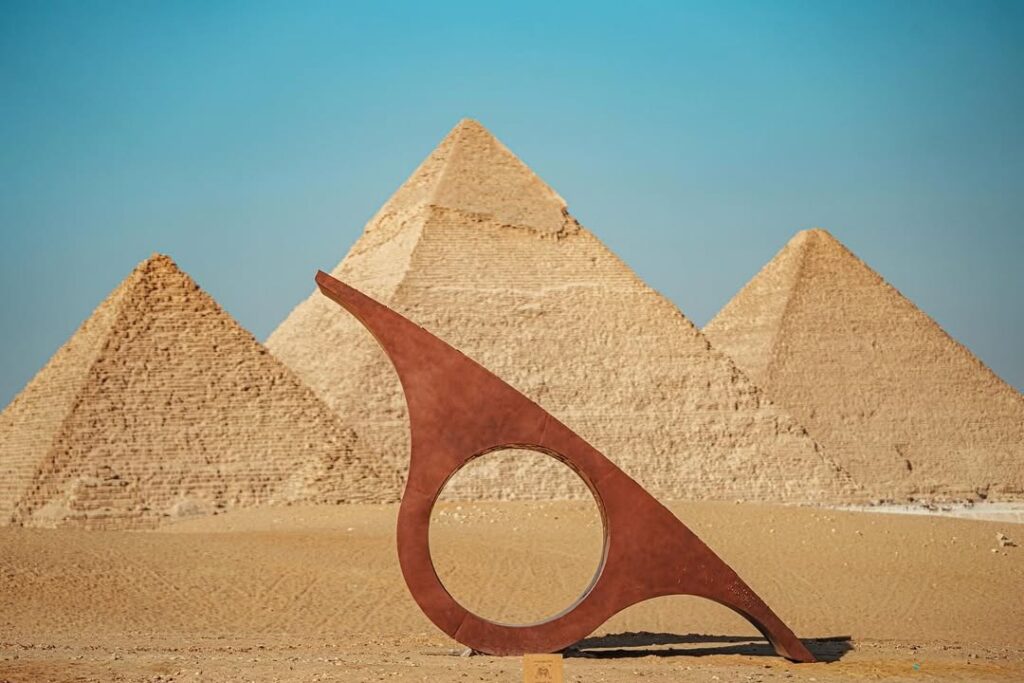
MA’AT- SALHA ALMASRY
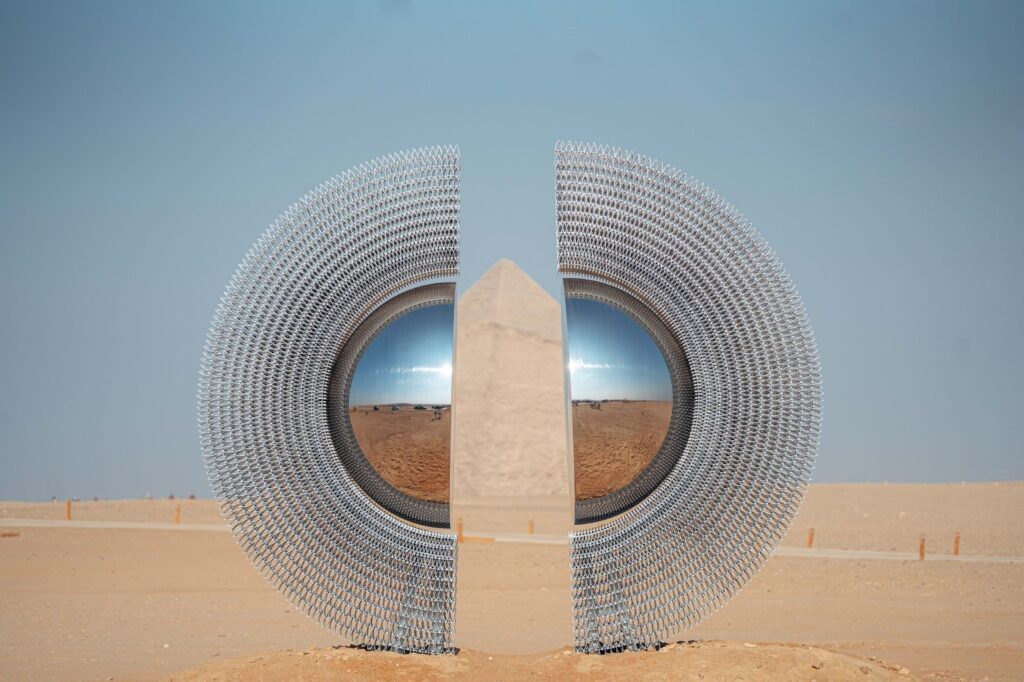
A bronze ring inlaid with carving, this piece by an Egyptian artist, a jewelry piece come to life, is a perfect way to end the exhibit. A seal turned covenant, it is inscribed with phrases from the Book of the Dead that revolve around dignity, justice, and bread—a promise from the powerful to the powerless. The circle that forms in the middle serves as a sign of balance (presence/absence, stone/void), but also as a window to the pyramids, connecting past and present.
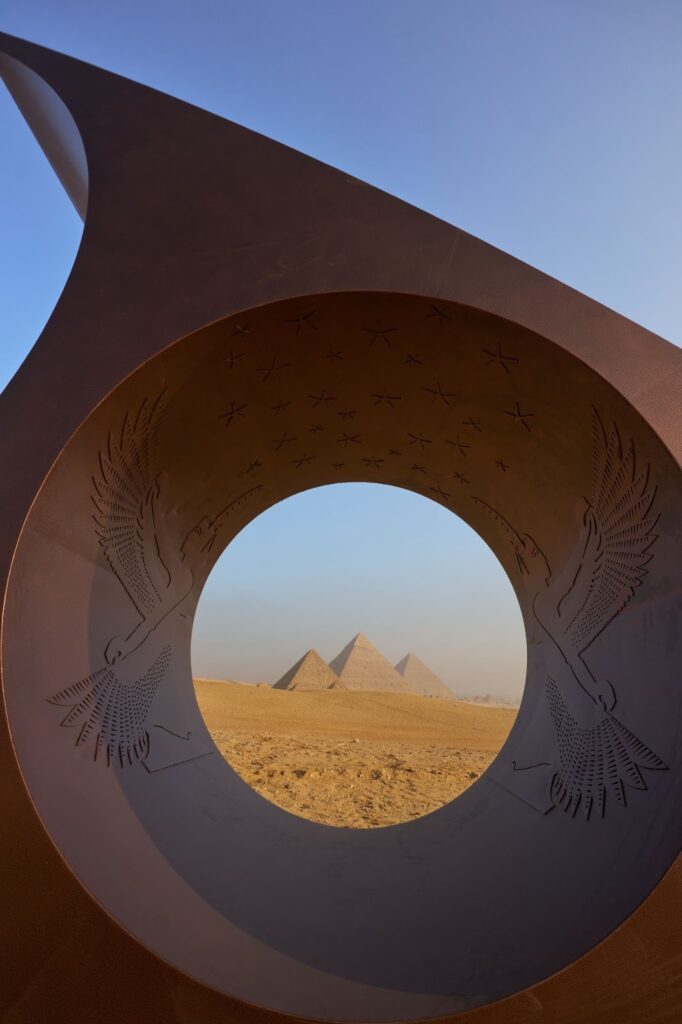
As I take in their majesty peeking through, I can’t help but be struck by the fact that no matter how often I’ve seen them, the pyramids remain a transcendent experience—a journey into groundedness and the true meaning of substance. If our time on this earth is meant to alter, if we are a shape that is solid, a presence borne of millenia, a collision of natural elements, then what truly is time?
What is forever?