 Flair Magazine
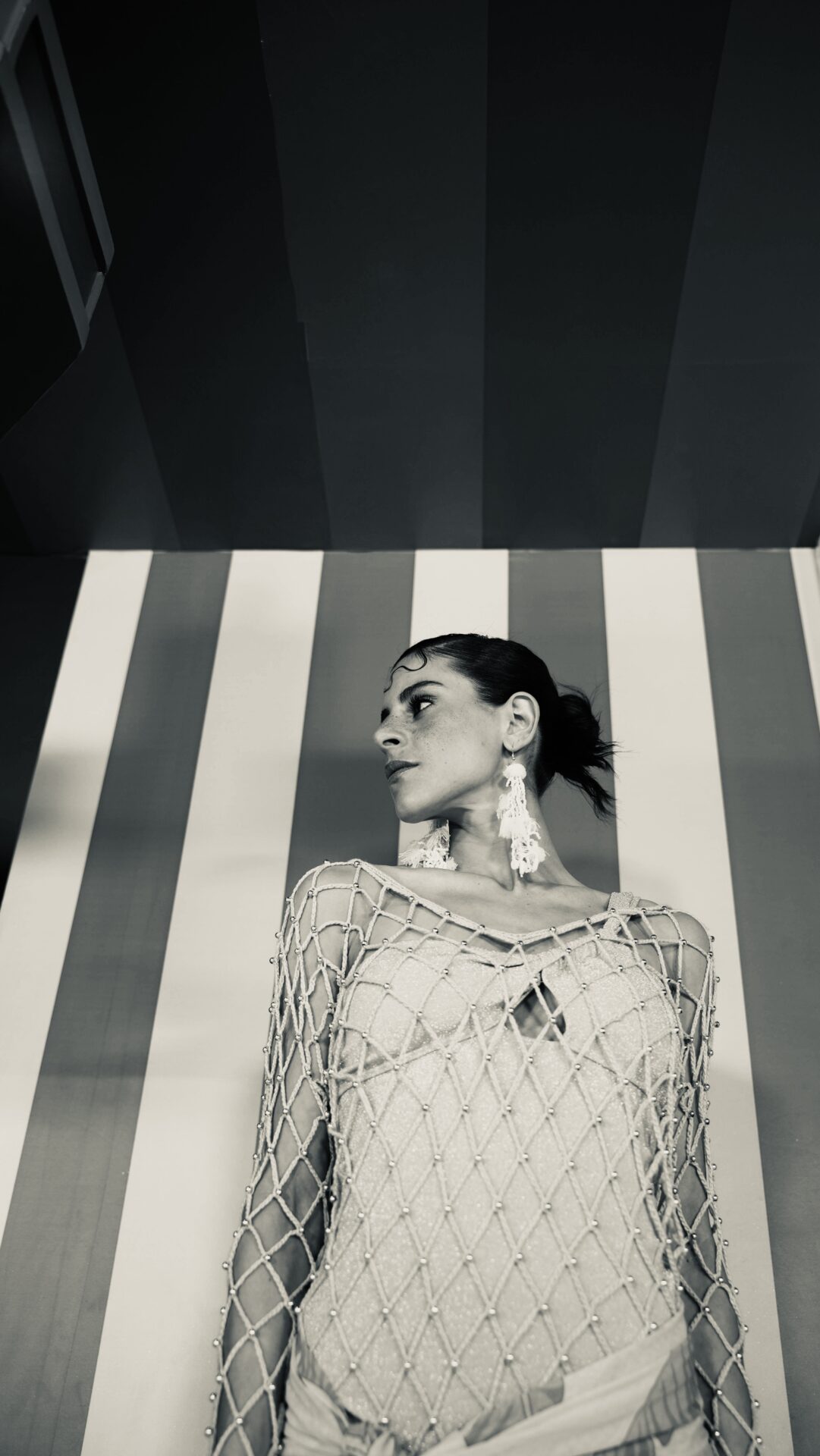
 To the untrained eye, Nada Abadir could be any other girl at the café — hair slicked back in a disciplined bun, a black-on-black uniform that whispers rather than shouts, tiny hand-sewn flower earrings that catch the light just enough to betray their quiet charm. But she’s impossible to miss. Her posture gives her away — erect, assured, the telltale grace of a dancer — and her eyes hold the kind of focus that belongs only to those who know exactly what they want, and are unafraid to chase it.
I’ve met many talented women in my life, but few who cross boundaries — and disciplines — with the daring consistency of Nada Abadir. Model, ballerina, actor, designer: her journey reads like a study in metamorphosis. At seventeen, when most dancers have already spent a decade at the barre, Nada fell in love with dance almost by accident. A self-proclaimed tomboy, Nada did not grow up around ballet or modern dance, but discovered it in her adolescence during a trying period in her life What began as curiosity quickly became obsession. “I would go home and do YouTube videos by myself every day,” she tells me, laughing. “I put up an Ikea curtain rod in my room and a small mirror and practiced for hours. I’d say I’m mostly self-taught.”
Soon, the girl dancing alone in her bedroom joined beginner workshops — surrounded by five-year-olds in pink tutus who teased her relentlessly. “Those children were mean!” she says with mock outrage. But she didn’t stop. Ballet, she tells me, made her feel present in her body for the first time. “It was the one thing I did every day that felt like an exhale.” Eventually, her persistence carried her across borders and into two European dance companies: Dance in Art in Holland, and Elephant in the Black Box in Madrid. “It was a challenge,” she admits, “but I was very excited to take it on.”
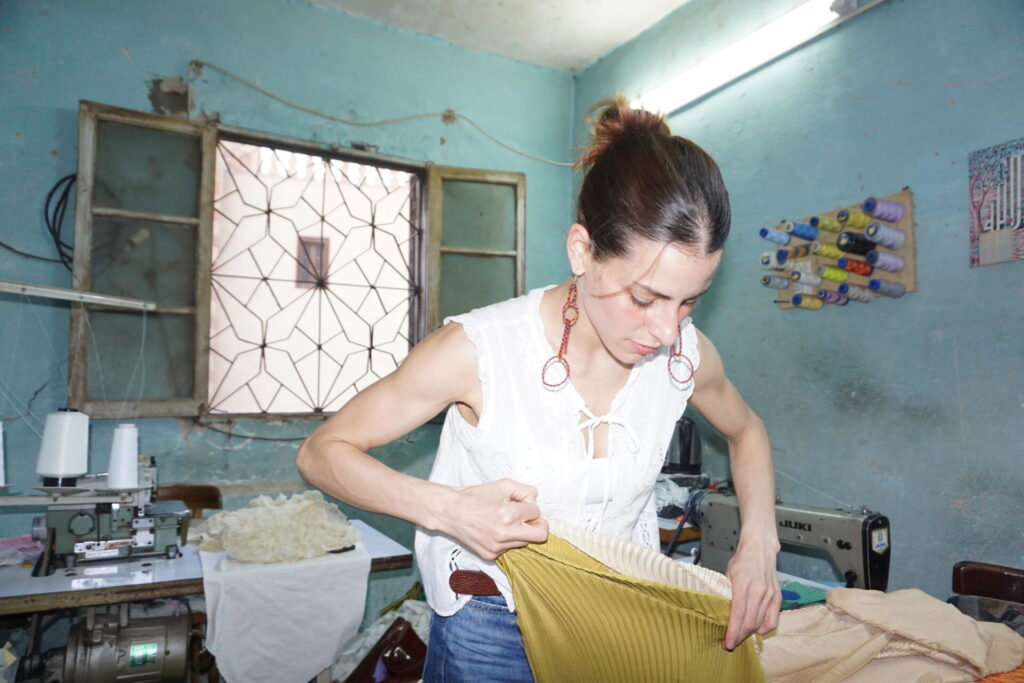
That same appetite for challenge — that sparkle of discipline meeting curiosity — defines everything Nada touches. You can see it in the way she moves through a shoot, tilts her head with intention, or adjusts a pleat until it sits just so. Today, she channels that same energy into her latest pursuit: her fashion label, Nuu Studio.
“Nuu is the Japanese word for ‘to sew,’” she tells me, correcting my assumption that it came from the French nu — naked. “I’m really inspired by the Japanese design identity. I wanted something stripped down that captures my obsession with dancewear, while embodying that sense of being in your body.”
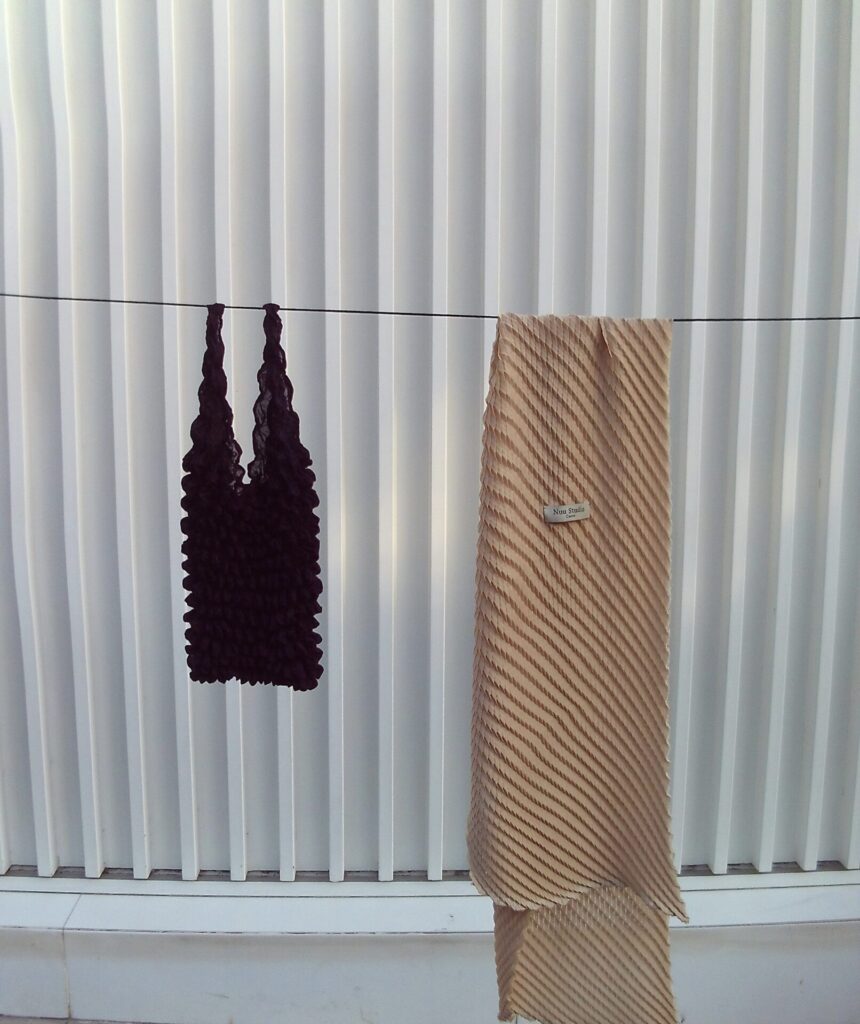
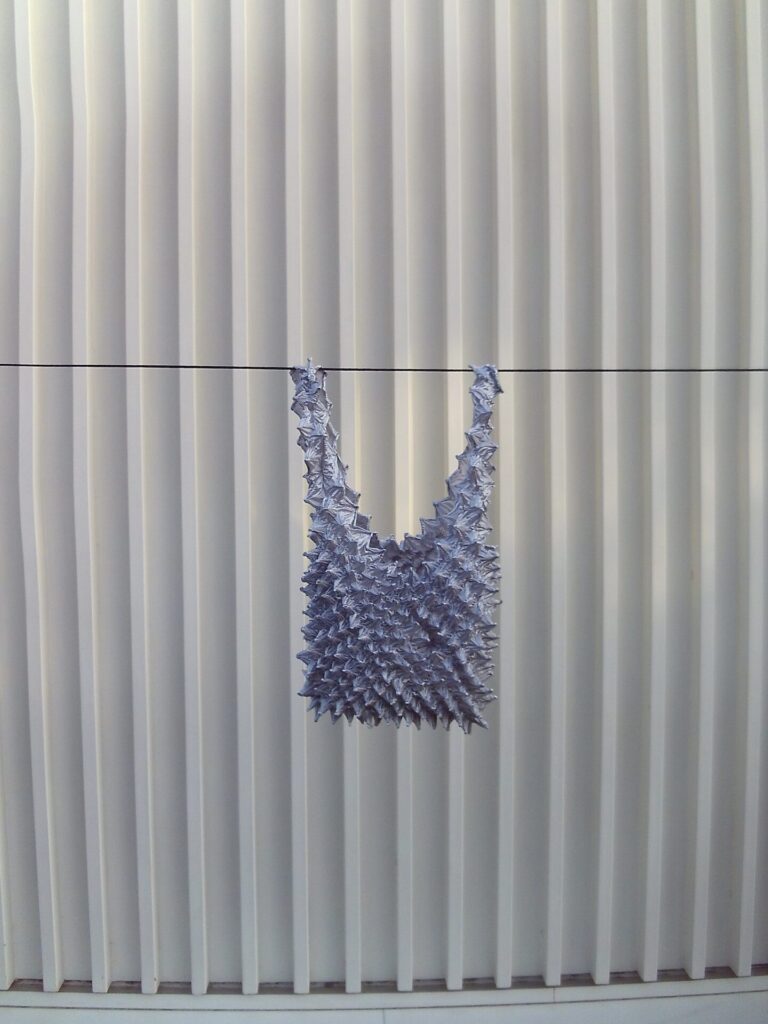
Her brand does exactly that. Nuu is a meditation on form and feeling — a merging of the dancer’s discipline and the designer’s eye. With its simple silhouettes, expert finishing, and quietly confident palette, her work celebrates restraint as luxury. Pleated trousers that move like breath, off-the-shoulder tops that recall the line of a dancer’s collarbone — these are not just clothes, but a language of movement translated into fabric.
“I’m obsessed with replicating the Japanese Shibori technique,” she says, eyes lighting up as she explains how she manipulates fabric, folding, twisting, and binding it before dyeing to create subtle movement and texture. The method mirrors her own creative process — one of repetition, patience, and transformation. “I incorporate pleats into almost everything I make,” she adds, “it gives the fabric life.” Nada often spends hours wandering Wekala in search of the perfect material, or returns from her travels with meters of silk that have caught her eye.
“My work is not loud,” she says softly. “It’s for those who appreciate quiet power — the lovers of slowness, of layering, of quality over quantity.”
Abadir’s pieces are created in small capsule collections, often from her living room, and released through her Instagram page. Her favorite piece, she tells me, is a green top made by accident — raw-edged, imperfect, yet somehow perfect. Her designs, I’d say, have that rare quality — the effortless allure of something considered. Like a pair of jeans that fit just right, her garments are both familiar and transformative — the kind of pieces the Egyptian market has long been waiting for.
As we talk, her mind dances ahead — to collaborations she dreams of (“I’d love to dress Yousra Mardini”), to designers she reveres (“Yohji Yamamoto, Issey Miyake — I’m obsessed”), and to futures not yet stitched. “Maybe someday I’ll join another dance company,” she muses, “or open my own shop.”
She smiles — the smile of someone already building the bridge between both. Watching her, it’s clear: Nada Abadir isn’t just creating clothes. She’s choreographing a life where movement, fabric, and form are one and the same.