 Sama Farrag
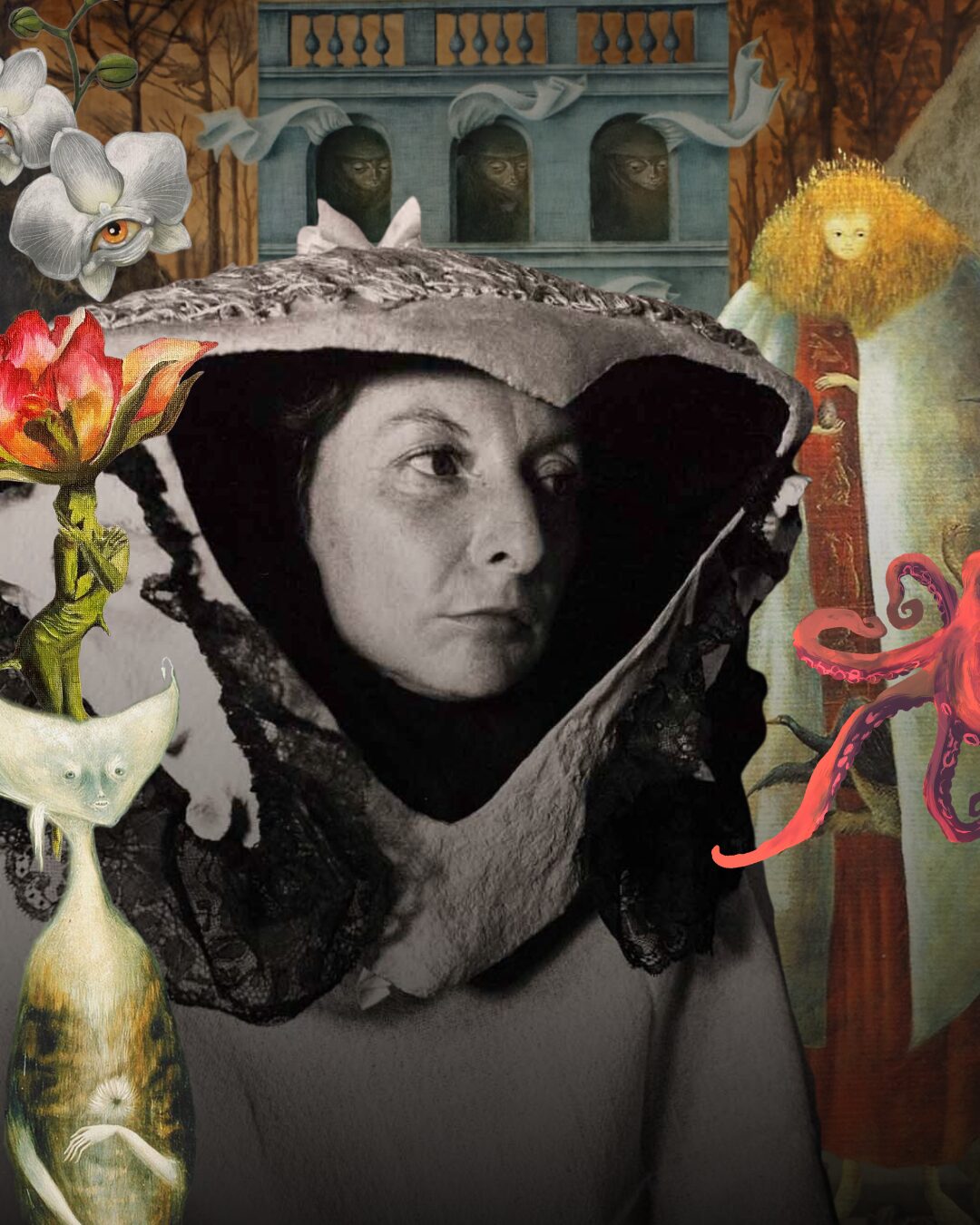
Ask anyone on the street to name a Surrealist, and you’ll get the exact same three answers: Salvador Dalí, René Magritte, and Max Ernst. The canonical art history syllabus loves its melting clocks, bowler hats, and hyper-masculine ego trips, conveniently cropping out the forgotten women of Surrealism who were doing the most subversive work in the movement – while still flattening them into muses, lovers, and hysterical dinner-party hosts draping themselves over grand pianos.
While André Breton and his inner circle were busy theorizing the female psyche as a passive vessel for male inspiration (groundbreaking, truly), the women of Surrealism were turning the subconscious inward, dissecting domesticity, occultism, and female rage with a precision the boys club never matched.
For a movement built on liberating the unconscious, the men in charge had a remarkably bourgeois imagination when it came to what women were allowed to dream about. They wanted compliant, childlike figures to spark their own genius. Instead, they got artists who were dismantling religion, colonialism, and the nuclear family on canvas. Even closer to home, Surrealism’s radical Egyptian counterpart the Cairo-based Art and Liberty Group (Jama’at al-Fann wa al-Hurriyya) had fiercely uncompromising women rewriting the rules of modernism right here in the late 1930s and 40s.
Remedios Varo
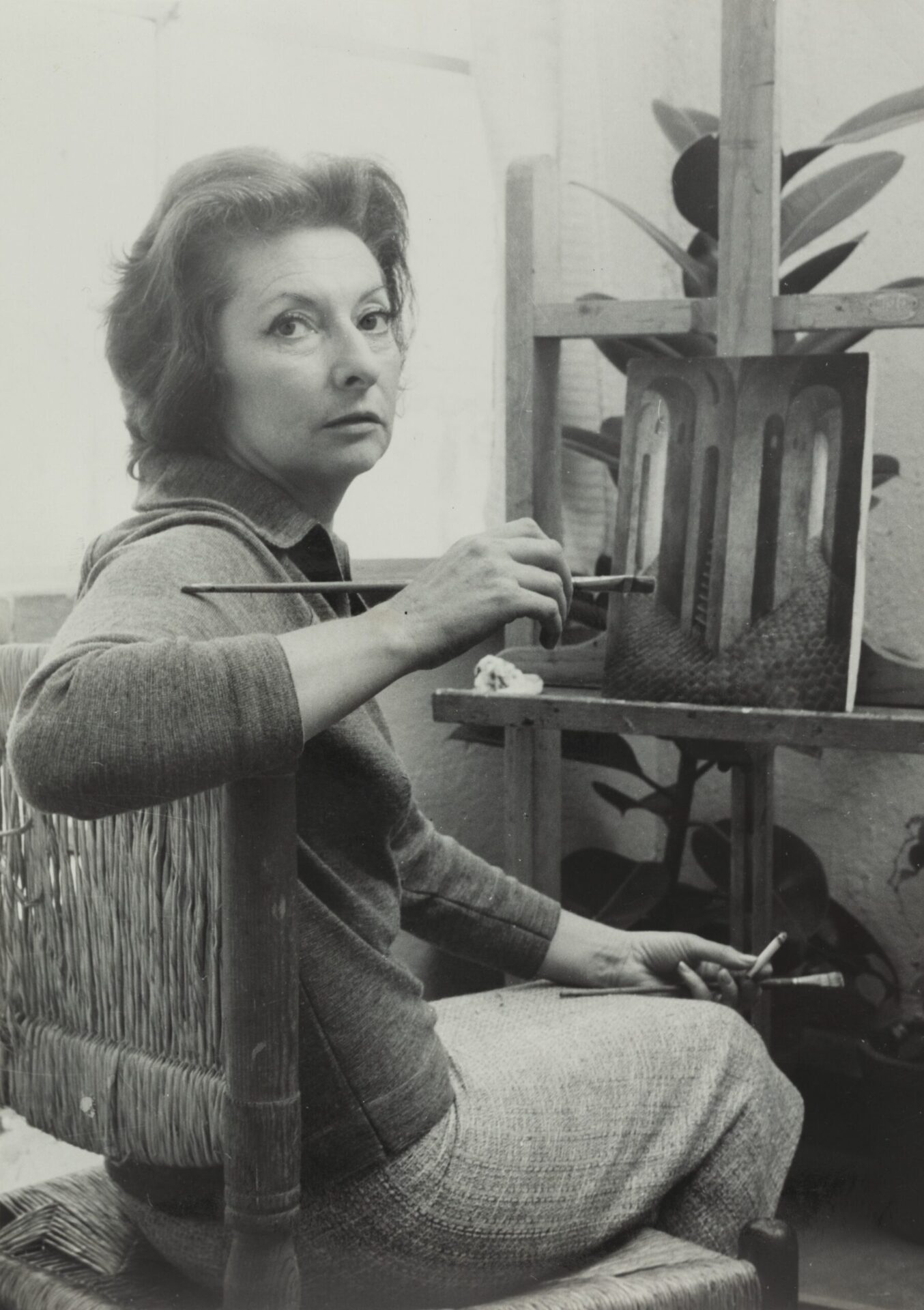
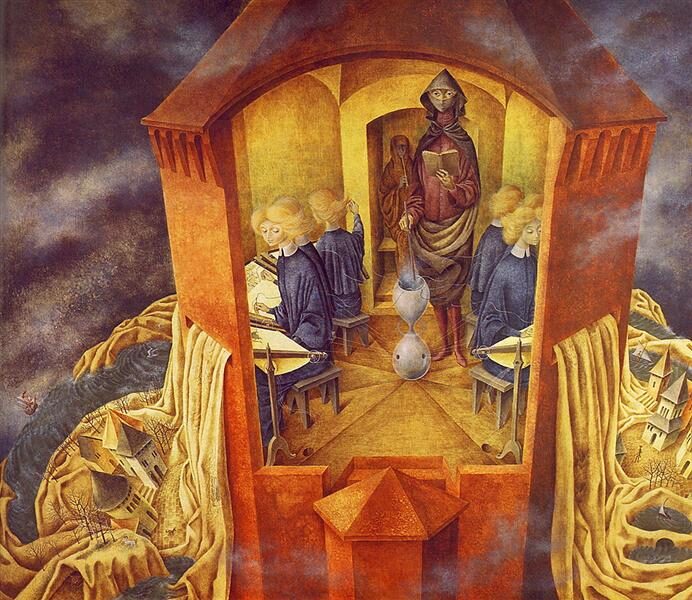
If Wes Anderson, Carl Jung, and Nicolas Flamel shared a studio in Mexico City, it would look like a Remedios Varo canvas. Born in Spain and exiled to Mexico during World War II after fleeing both the Spanish Civil War and the Nazi occupation of Paris, Varo painted luminous, hyper-detailed worlds populated by androgynous, owl-faced women weaving the fabric of the universe, distilling starlight, and escaping walled towers on wheeled cloaks.
Her canvases, like Embroidering the Earth’s Mantle and Exploration of the Sources of the Orinoco River, are packed with intricate clockwork mechanisms, celestial vessels, and alchemical laboratories that feel half medieval manuscript and half sci-fi schematic. Varo grew up learning technical drafting from her hydraulic engineer father, and that pedigree shows in every razor-sharp brushstroke. Where her male peers treated the unconscious like an indulgent, absurdist fever dream, Varo approached mysticism like an empirical science – creating blueprints for female autonomy rather than passive hallucinations.
Leonora Carrington
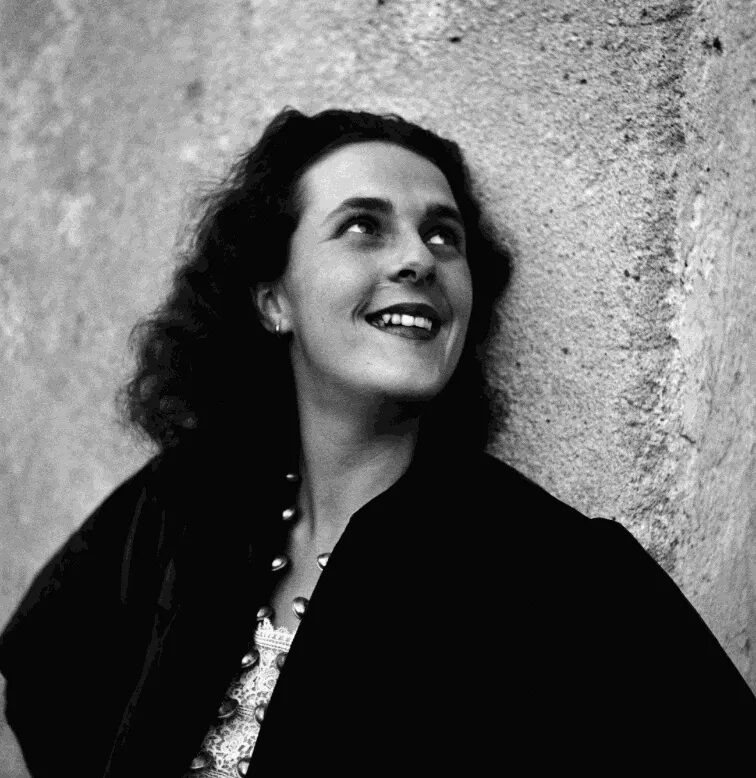
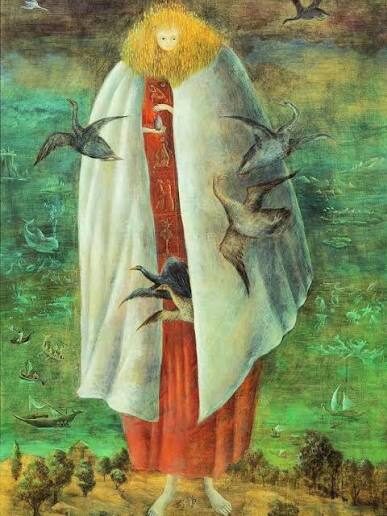
Carrington famously walked away from her aristocratic British debutante life – complete with a presentation at King George V’s court that she openly despised – ran off to France with Max Ernst, survived a harrowing institutionalization in Spain after Ernst was detained by the French authorities, and eventually found her artistic sanctuary in Mexico alongside Varo. Their friendship became one of the most productive creative partnerships in 20th-century art, fueled by tarot, Jungian psychology, and a shared refusal to play by European art-world rules.
Her paintings are feverish, mythological ecosystems where hyenas attend debutante balls in her place, giantesses cradle cosmic eggs, and alchemy happens in the kitchen. In works like The Giantess (The Guardian of the Egg) and Self-Portrait (Inn of the Dawn Horse), Carrington replaced the male gaze with Celtic folklore, animal familiars, and domestic sorcery. She rejected the Surrealist obsession with the femme-enfant (the naive child-woman muse) entirely, insisting she didn’t have time to be anyone’s muse because she was too busy rebelling against her family and learning to be an artist.
The Women of Cairo’s Art and Liberty: Amy Nimr and Inji Efflatoun
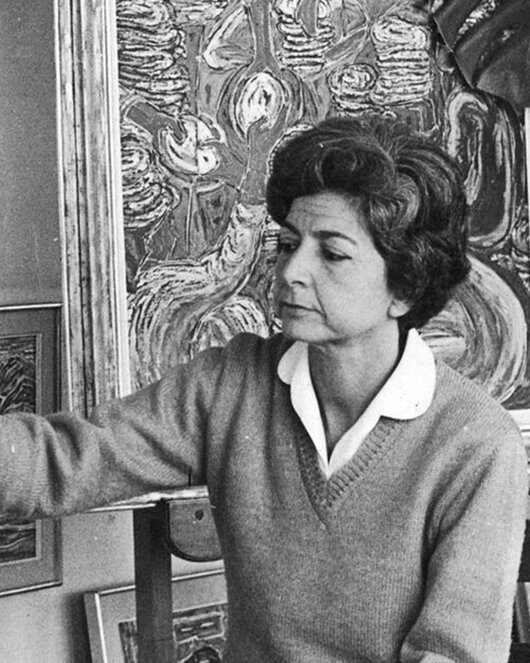
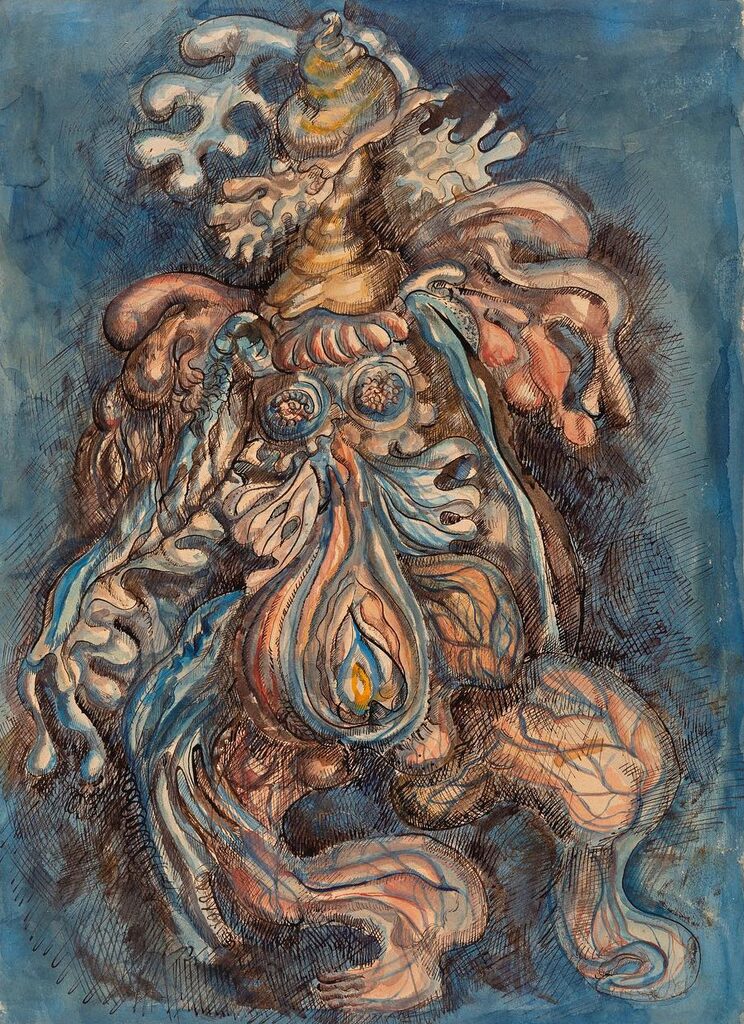
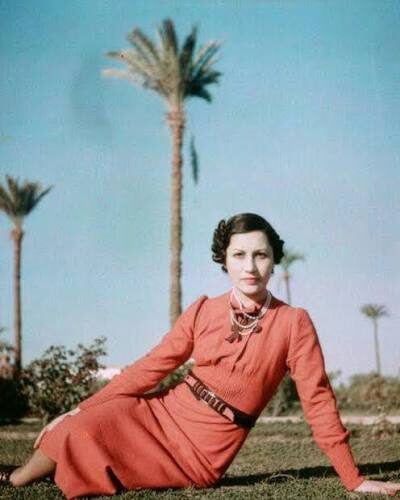
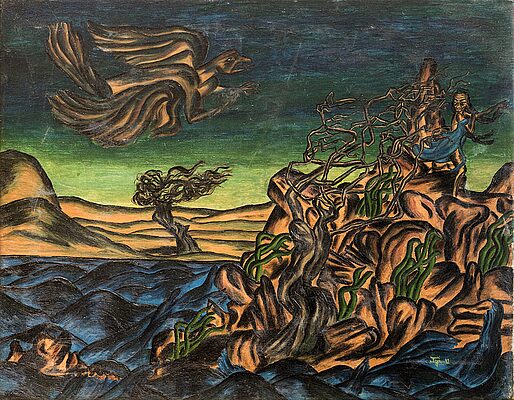
Before Surrealism was packaged into museum gift-shop posters for people who haven’t read Lautréamont, it was an anti-fascist, anti-colonial weapon. Founded in 1938 in Cairo with the Long Live Degenerate Art manifesto, the Art and Liberty Group rejected both academic nationalism and European fascism, carving out a radical space for political and psychological freedom in Egypt. While Inji Efflatoun is widely celebrated as an Egyptian modernist icon, her early formative years in the 1940s were deeply rooted in Cairo’s Art and Liberty movement, where she painted visceral, stormy landscapes of female liberation and psychological revolt – canvases charged with windswept trees, trapped figures, and a vehement refusal to play nice.
Alongside her was Amy Nimr, whose Cairo salon was a hub for the group’s writers, poets, and painters, and whose own canvases – haunting depictions of skeletal figures, desert ruins, and wartime trauma – bridged European Surrealist techniques with raw Egyptian reality. Nimr’s work confronted the physical and psychological wreckage of World War II in North Africa head-on, trading glossy European dreamscapes for something far more concrete and grounded. History often reduces both women to footnotes in a male-led manifesto, even though their work carried the emotional weight of the era.
Dorothea Tanning
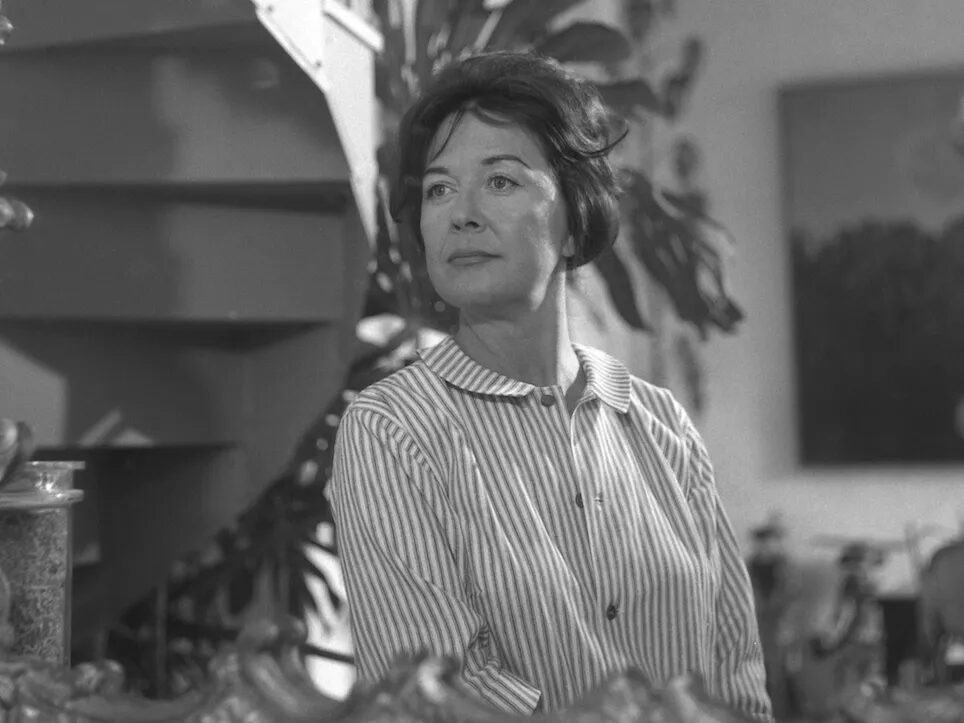
Before she married Max Ernst – and for the thirty-six years she outlived him – Dorothea Tanning was painting the uncanny horror of the American Victorian home and exposing the rot inside it. Her breakout 1942 self-portrait, Birthday, features her bare-chested in a jacket of gnarled roots with a winged lemur at her feet and an endless corridor of half-open doors stretching into the background. Legend has it that Ernst took one look at the painting in her New York studio and promptly left Peggy Guggenheim for her, though Tanning’s body of work makes it clear she was never going to play second fiddle to her husband’s legacy.
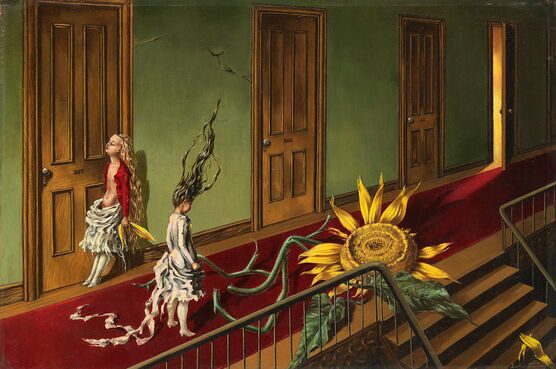
Tanning took the cozy and slightly suffocating, lace-trimmed tropes of 19th-century domesticity – wallpaper, bedrooms, parlors, little girls – and twisted them into sheer psychological gothic. In canvases like Eine Kleine Nachtmusik, giant sunflowers creep down a hotel hallway while young girls stand frozen against peeling walls, capturing the exact moment childhood innocence curdles into dread. If you’ve ever loved the aesthetics and eerie tension of Sharp Objects or The Virgin Suicides, you’re looking at Tanning’s visual DNA.
Kay Sage
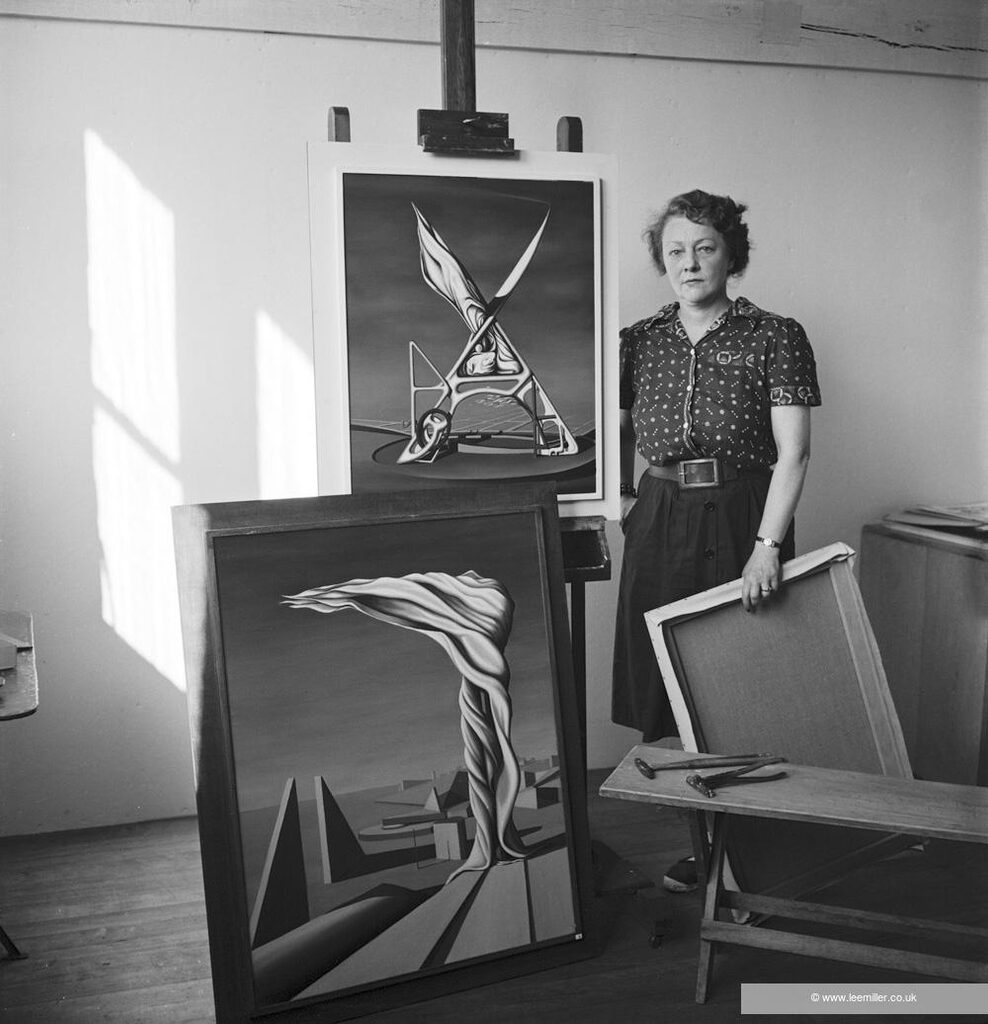
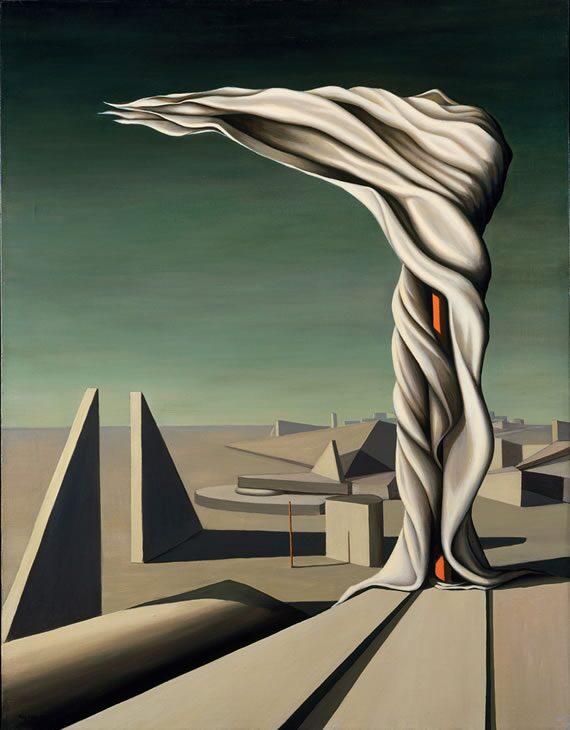
Often overshadowed by her husband Yves Tanguy (because apparently even in the metaphysical realm, a woman’s career still comes second. Sigh.) Kay Sage’s canvases are some of the coldest, sharpest, and most hauntingly architectural works in the entire Surrealist canon. Born into a wealthy New York family and largely self-taught, Sage bypassed the lush, biological weirdness of her contemporaries in favor of something far more austere.
She painted vast, desolate plains occupied by towering, scaffolded structures draped in heavy, sculptural fabric. Monuments to isolation, silence, and emotional containment. In paintings like I Saw Three Cities and Tomorrow Is Never, latticework cages and sharp geometric forms rise out of barren landscape bathed in a flat and shadowless light that feels like the morning after the end of the world. Eschewing melting watches and theatrical shock tactics altogether, Sage built a surrealism defined by stoic precision, where an empty, sun-bleached scaffold carries more dread than any monster.