 Hedayat Reda
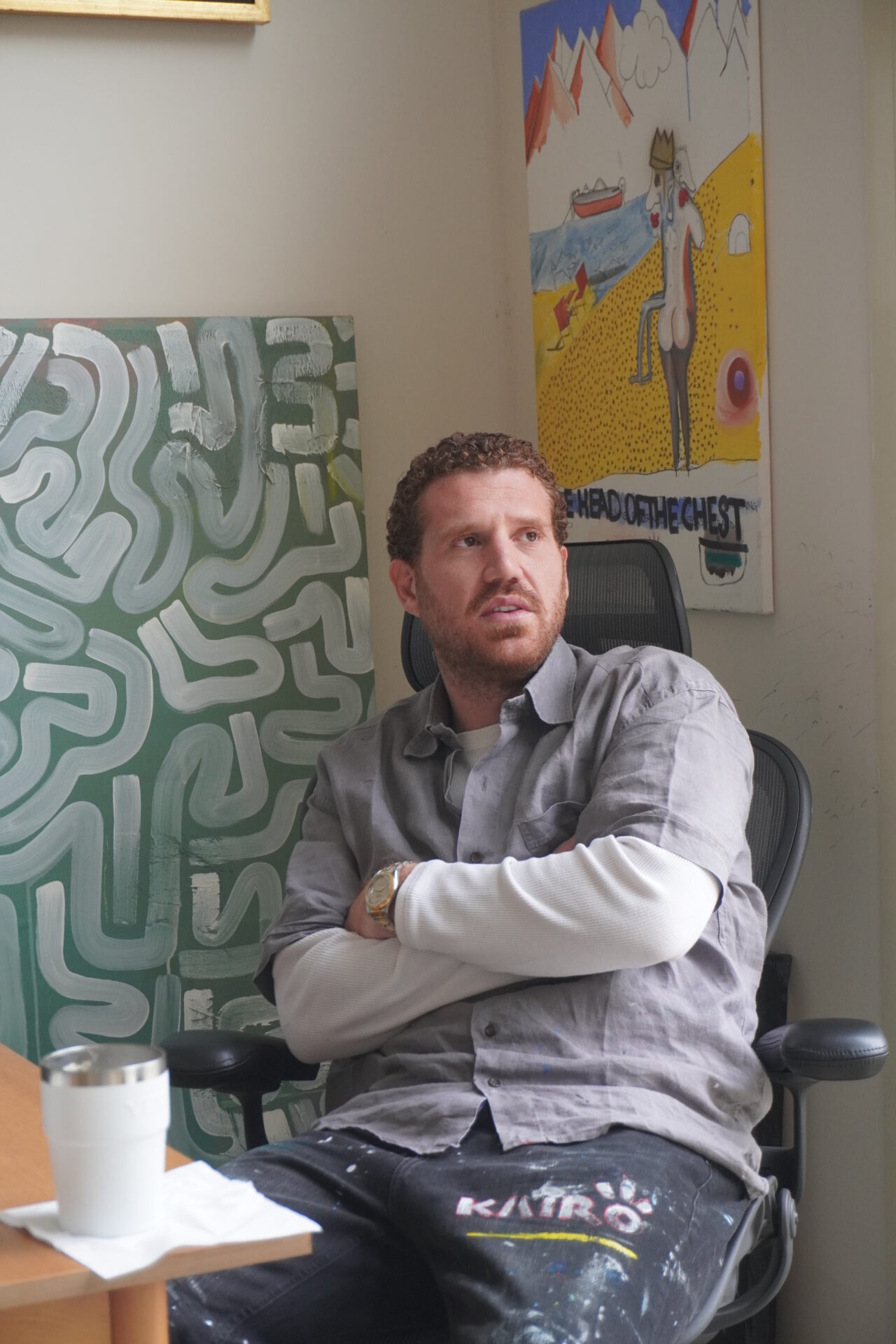
 In the event that art is dead Kairo Lumumba will tell you to go back to intuition. To follow your instinct, and put paint to canvas, and just…flow. An artist that comes around every few decades or so, this Alex-raised transplant is bringing a new vision of what contemporary artists can look like; how art can traverse disciplines and instill itself into those it had previously forgotten. How does one go about framing the unframeable?
“The hardest thing to do as an adult is to unlearn what we have been taught. One of my first teachers in illustration, Professor Walid Taher, would tell us not to focus on drawing techniques and theory, but on the mind and how it thinks. Children construct things with innocence and purity–that idea has stayed with me.”
Stepping into Kairo’s ground-floor glass studio is an initiation into another world, one in which art takes centre stage, regardless of the canvas it’s on. From discoid pottery, to rough-woven rugs, to cotton t-shirts, to paintings on paintings on paintings, Kairo (or Ahmed, as he actually introduces himself) has done it all, with a vivaciousness and cheek that mesmerizes and leaves you asking profound questions.His palette ranges from dark charcoal greys, to bright azure blues, to a shade of red I hesitate to call brick, to papier-mâché white, to mustard yellow. In a season devoid of colour, this foray into the art world feels like a breath of fresh air.
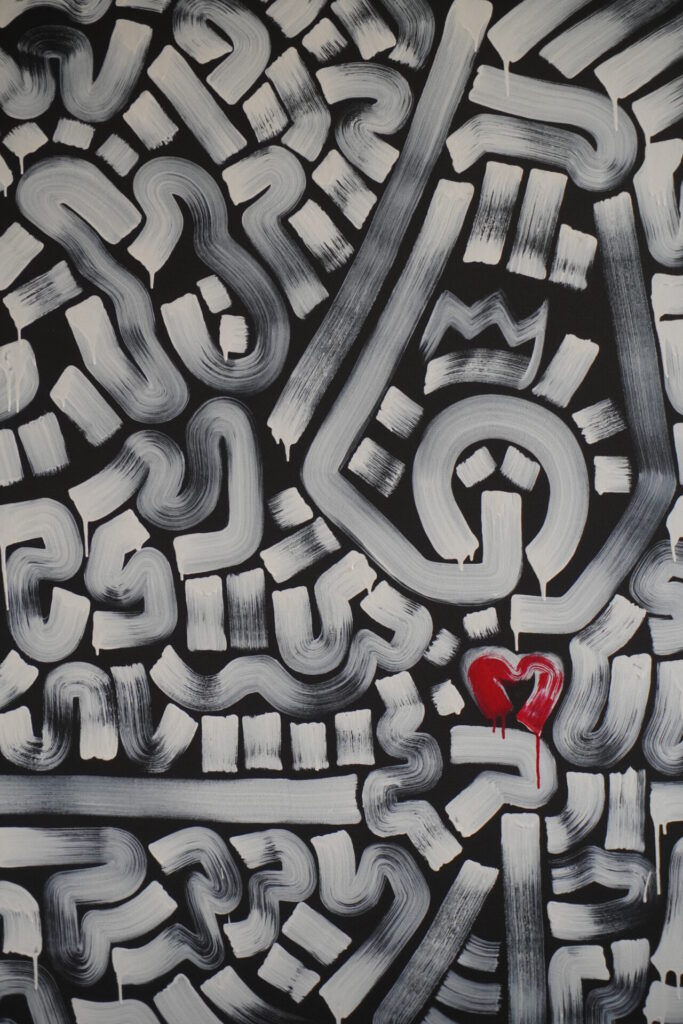
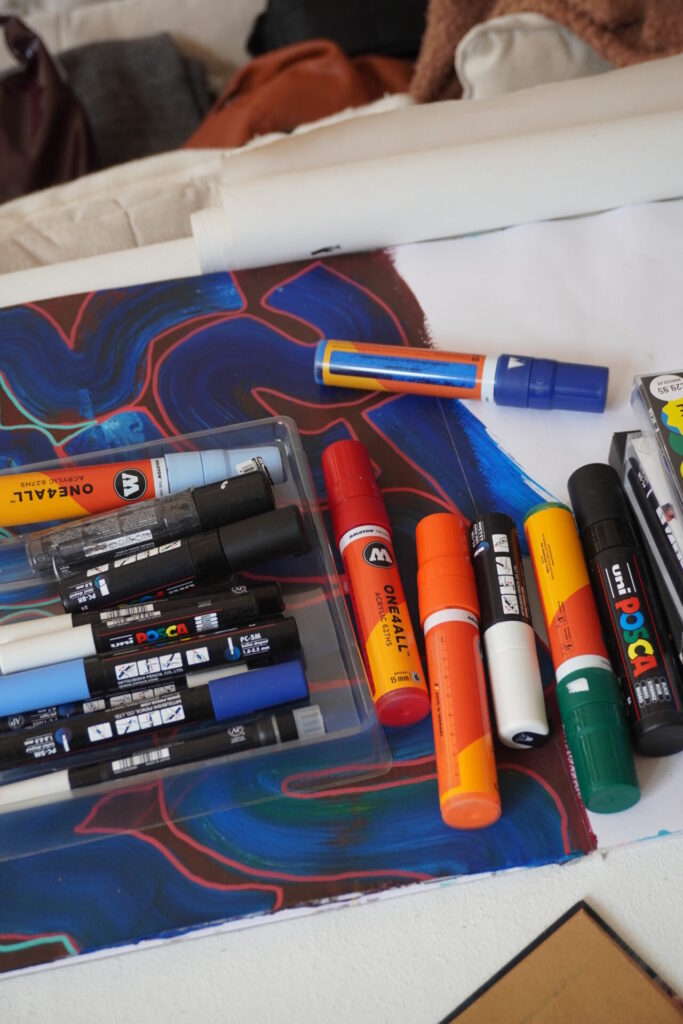
“You can tell a lot by a person the way they draw a line,” he instructs me into a painting secret he learned from a professor. The topic is Keith Haring, the American pop-artist to whom his work has frequently been likened, due to their penchant for doodle-like squiggles and graffiti flair. However, Kairo maintains that he does not really consider Haring as one of his influences:
“Our strokes are different. We don’t use the same language,” he shows me how his brush strokes are wider, his concepts more abstract.
“I never used to look at other artists’ works, I was worried I would lose my own identity. But now I know it is hard to dilute, I realize that you can’t lose it, and I am starting to see more how important it is to learn from others’ works,” he indirectly addresses the Keith Haring book he has been gifted that lies prominently displayed on his desk.
As a young child, Kairo was not really into art. His most vivid memory of an art encounter that moved him and stayed, was the first painting he made in the fifth grade. He was very proud of it, even had it framed with the intent of showing it to his class teacher, but upon sharing it with her, thinking he would receive praise, he was, instead, met only with criticism.
“You left too many negative spaces”, she critiqued his proud work, putting him down and leaving him feeling very demotivated. While it did not make or break his artistic integrity at the time– he insists art did not really find him until 15 years later in life. Today, negative space plays a big role in his artistic work.
“Maybe subconsciously you absorbed her criticism?” I joke, utilizing my Intro to Psych background and taking in the shadows between brush-strokes, the contrast of light and dark.
“Maybe,” he responds good-naturedly, humouring me.
Talking to Kairo is like taking a walk down the Corniche in Alexandria: languid, natural, and easy. He mimics the art he portrays, dressing vivaciously, speaking in big language, smiling often, hosting humbly. Prior to this interview I was feeling uninspired, wondering if our voices as creators are heard, in the digital overload that is today’s world. But as Kairo takes us through his various collections, contextualising previous and current work, I see a spark of what connects art and humanity.
“I try not to overthink. Art for me is an intuitive process. In life you have to use your head a lot, you have to use logic a lot, but in art it’s more about yourself: how you’re feeling, what you’re doing, how you’re seeing things and what you are perceiving– your body becomes a vessel for what your mind is creating.”
“How do you challenge yourself to keep unlearning?” I ask, tying this to our earlier convo. “How do you not stay in a specific style?”
“I rarely know where a painting is going before my paintbrush touches the canvas. As I am maturing, I’ve become more in tune with my visual ideology before I paint.” Kairo takes me through his latest project: a painting featuring the words Kairo, laid out textually next to each other, with a cartoon-like character of a girl super-imposed on it. He explains that as he was painting, a sentence that a girl had once said to him came to his mind, and he immediately felt the need to integrate it into his existing work.
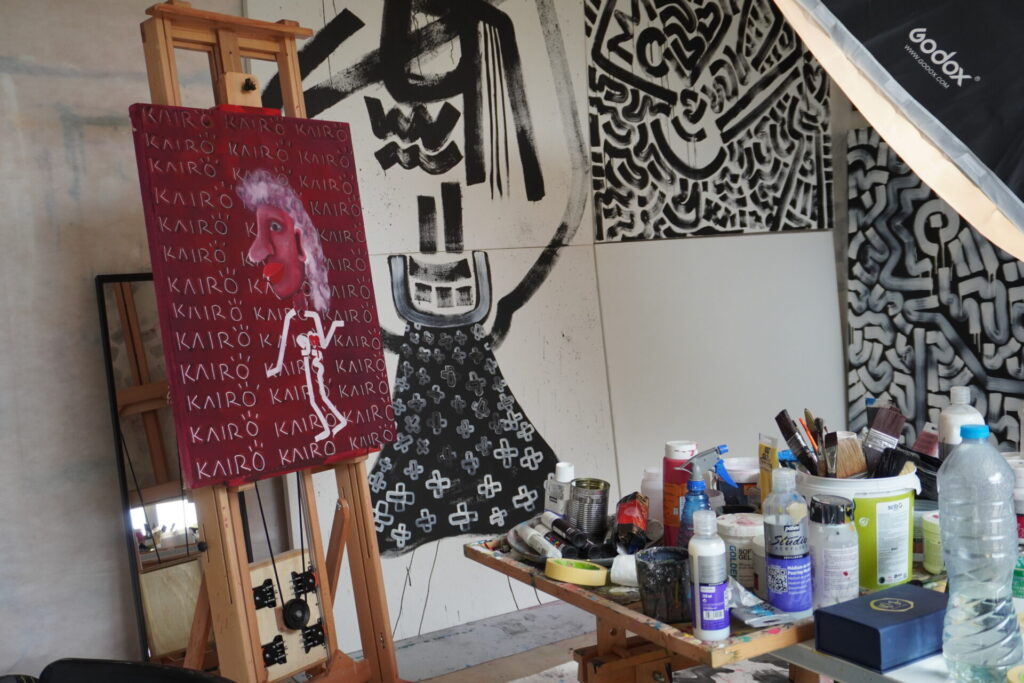
“How do you know if a painting is finished?” I survey the painting in question, wondering where it is in the creative process.
“I think the more you do it, the more intuitive it becomes, it just feels right,” he answers honestly, musing aloud. “One of my friends who is also an artist at heart, if not by trade, believes that is the hardest thing to know,” he continues. “There’s definitely a technical aspect to it where it just sits right with the eye. Sometimes things just feel balanced: the contrast feels right, the colour-scheme is on point, it feels dynamic enough. There’s a lot of different aspects that the mind calculates, without us being fully aware. That’s what I’ve acquainted with this instinctual feeling.”
“Since we’re talking about art, we also must talk about music”, I open the floor to the topic of the Kairo Sessions, his musical series in which he collaborates with and features prominent artists in the backdrop of his artwork (sometimes, as his artwork is being created live).
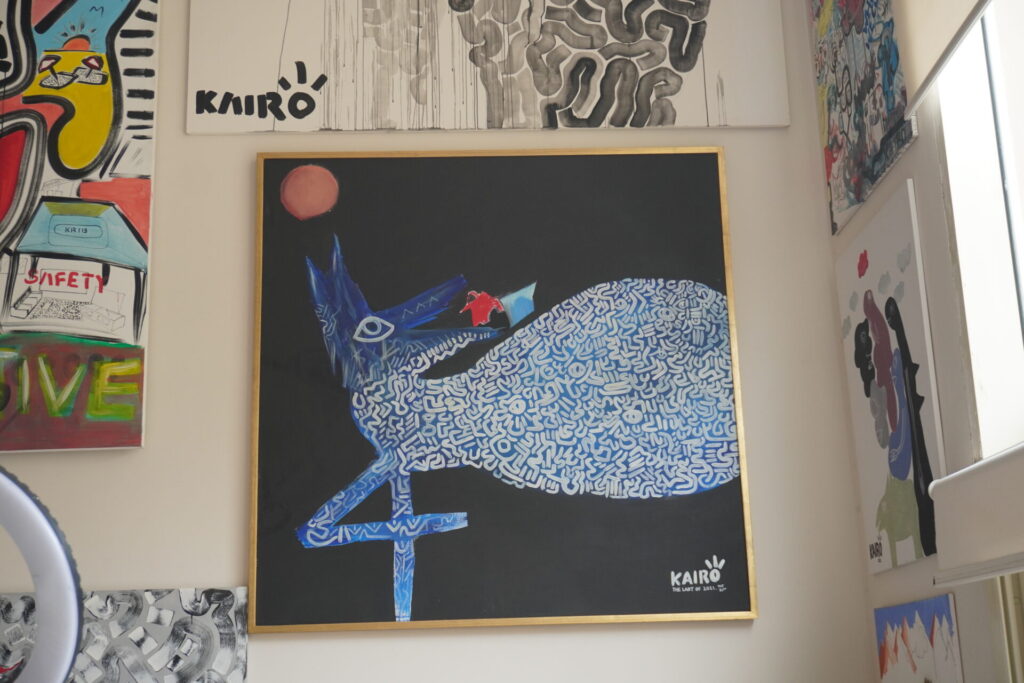
“Music is a part of my life, and– I believe–any artist’s life. It moves us. Even those who don’t actively listen to music, love the sounds of nature: the wind, the breeze, the birds, the leaves. When I came to the studio one of the first things I saw was a live concert happening here,” he gestures to the corner beneath his array of painted canvases, with the floor-to-ceiling glass doors letting in the afternoon light.
From Lila Ike to THATGIRLSHERRYK to Mira Bahgat, Kairo has collaborated with a selection of very versatile, very distinct artists to bring together the best of the creative world.
Curiously, I ask him about his Spotify Wrapped, wondering what kind of tunes create this very eclectic mix of visual extravagance. He hasn’t seen it yet, so we open it together and I discover that his taste is as diverse as his art work, ranging from soul pop, to deep house, to reggae.
“What I’ve realized is I tend to listen to more fast-tempo music. It’s very high energy when I’m painting most of the time. I also stick to my likes, I listen to the same songs over and over again.”
“What’s your listening age?” I ask, curious, not wanting to divulge how pre-pubescent mine is.
“23”, we discover together unexpectedly. I feel less bad about my Taylor Swift-induced 22.
On the topic of his artist name–Kairo Lumuumba– Kairo/Ahmed explains how it is an homage to the places that raised him.
“I came up with it at home on my couch. Patrice Lumumba was a significant character in African politics (he is currently making a comeback). I grew up in a house on Patrice Lumumba Street in Alexandria. The idea was to never forget where I came from. That’s where I came from, from Lumumba Street.”
“Do you feel like there’s an artist who inspires you with their work today? Or someone who is no longer with us?” I am curious about his influences.
“Picasso and Basquiat. Those to me are the top. Until today, you see their art and never get bored of it, it’s like seeing it for the first time. I think the most impactful artwork is the artwork that you don’t necessarily like at first sight, but the artwork you love over time. The more you see it, the more it grows on you, the more it becomes beautiful over time. That’s the artwork that I consider timeless.”
“Do you also keep up with Egyptian artists?”
“I’m a huge Hady Boraey fan. I love his artwork. I’m inspired by his amazing technique. The way he can make things so dynamic and have depth, but flat at the same time is very inspiring.”
“Do you want to take us through some of your favourite pieces that you’ve created?” I take a small tour of the room, wondering which of the many striking visuals hold a special place in his heart.
“See the shadow up there, that’s me and Kairo,” he points to a painting hung at the very top of the wall of two people/shadows in grey and black. “When I first got this studio and I had done my first big solo show, I was in a small two-bedroom in Tagamoa and there was no place to move because of all the artwork. I would sit there for hours and I would draw houses with high ceilings and a studio, like this one,” he gestures to a small sketch of a house on his desk, that uncannily resembles the space we are in now. “When I first thought to move, this is the first place I saw, the first place I walked into.”
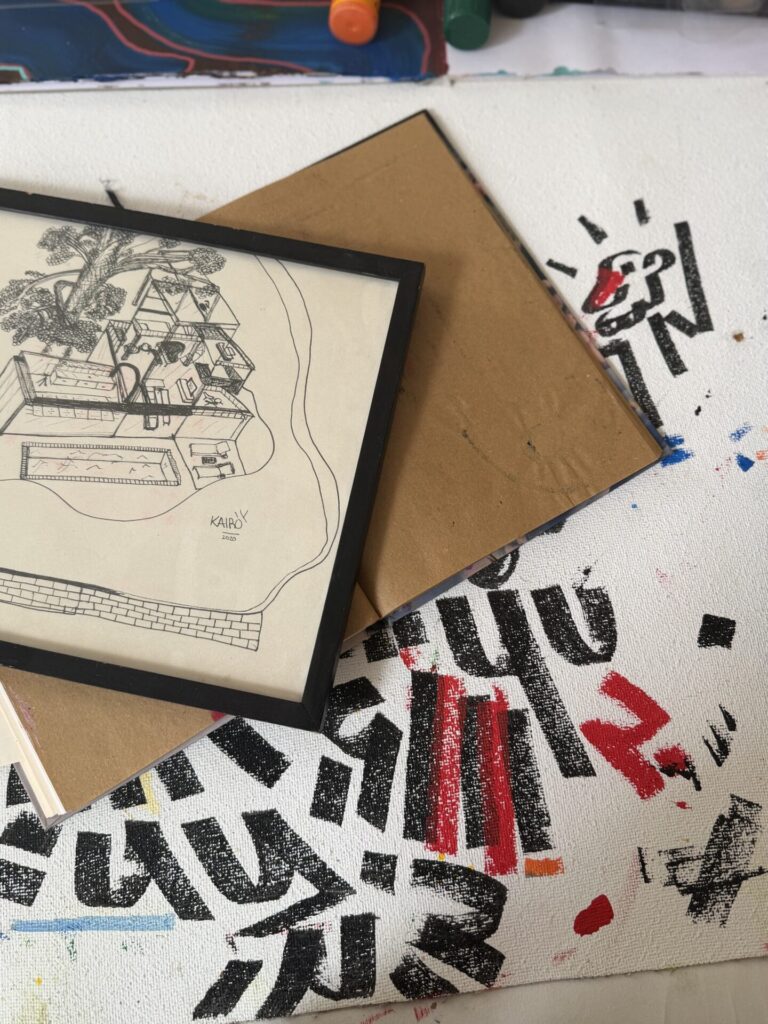
“You manifested it,” I say only half-jokingly, taking in the small ink-like drawings, the little furniture pieces in the house, the detail. That this sketch is one of his favourites, only makes sense when you see it in person.
“What’s next for Kairo? Do you have any shows you’re working on?”
“I’m currently working on a collection for an exhibition this year, hopefully it will be bigger and better. We’re also launching our website, where you can buy drops from our collabs and smaller art pieces (for the bigger ones, you have to communicate with Kairo’s team– I asked). We’re gonna keep playing with artwork on pots and vases…”
I want to ask about the next Kairo Sessions, but a part of me also wants to be surprised. There is a thought that Kairo leaves me with that I cannot get out of my head, when asked about the topic of rejection in the art world.
“For me art was not about acceptance, it was about standing apart, standing out. What does everyone leave behind when they’re dead? What do we leave behind other than the stories people have of us?” he utters entirely confidently.
It seems to me a juxtaposition to stand out, and yet be remembered, but that is also the line we are always teetering on in life. As artists, as creators there is a drive to be remembered, and yet that is only possible in community. Be great, do it together.
For now, this seems to be the right way to end this art work.